
October 29, 2026
Dental Implant Cost in San Diego (2026): Single, Bridge, Full Arch


Dental implants in San Diego cost $3,000 to $6,000 per tooth for the implant, abutment and crown, and most single implants land between $3,500 and $5,000. Each treatment is described on our dental implants in San Diego page. This blog will walk you through single, bridge and full arch prices, insurance, HSA money and treatment time.

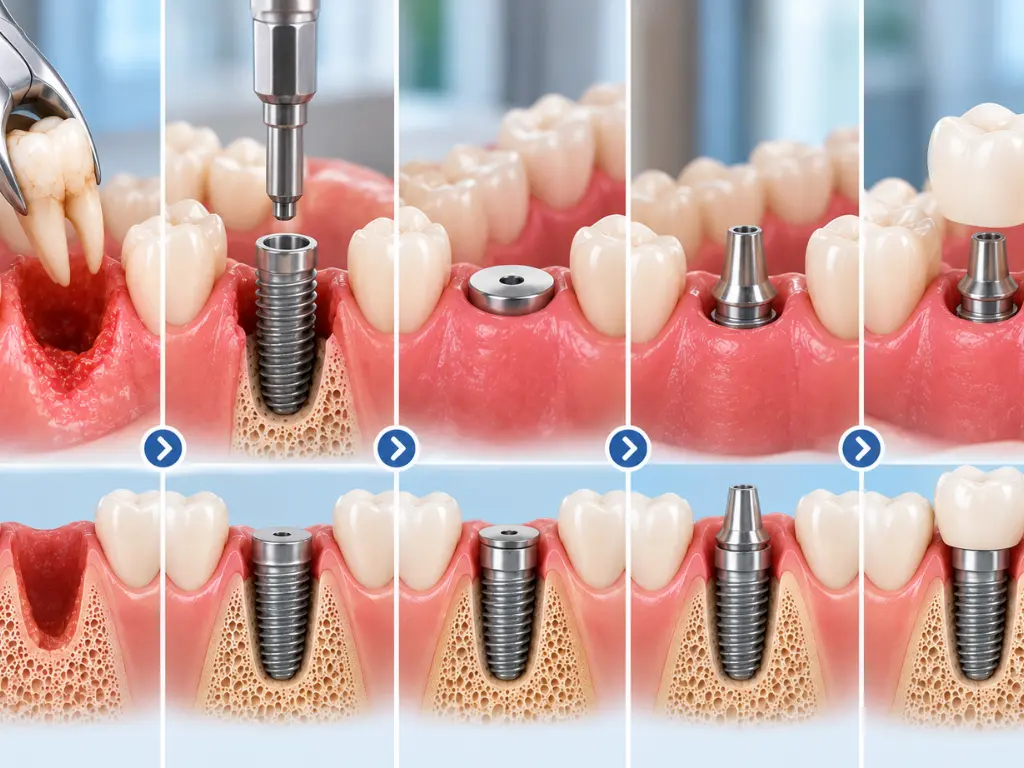
A dental implant price covers three parts that dentists bill separately: the implant body, the abutment and the crown. The implant body is a titanium post placed in the jawbone, billed under dental procedure code D6010. Over the following months the bone fuses to the titanium, a process called osseointegration, and the post becomes the new tooth root.
The abutment is the connector that screws into the implant and holds the crown. The crown is the visible tooth, made by a dental lab to match your other teeth and billed under D6065 when it is porcelain or ceramic.
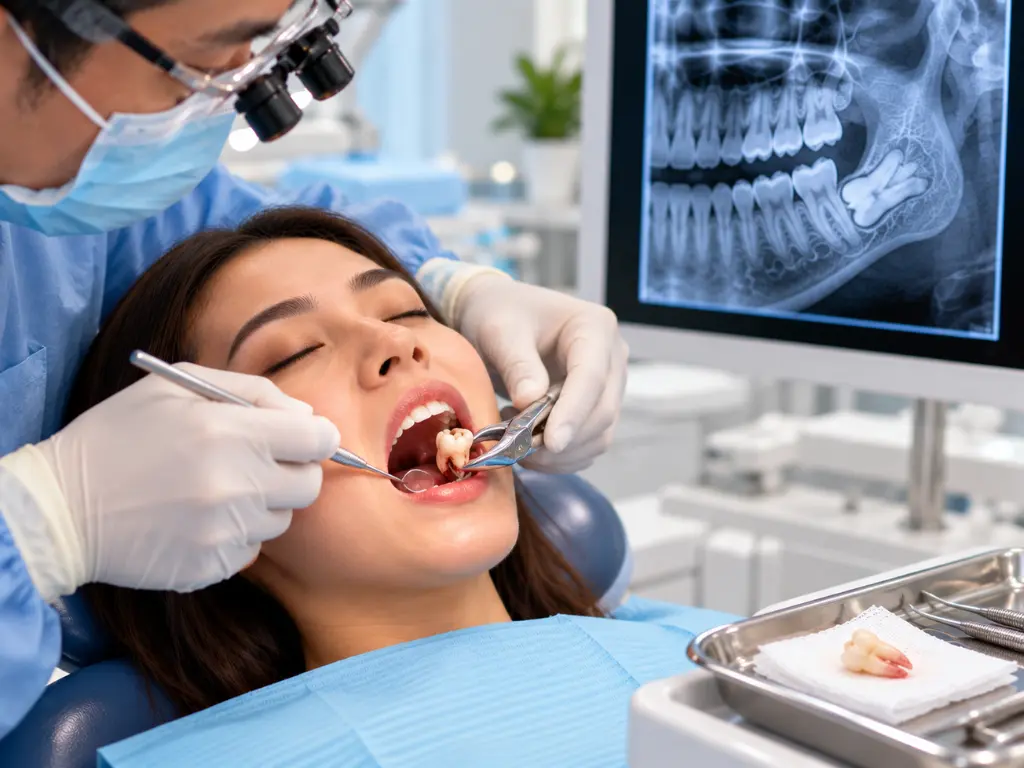
Around those three parts sit the steps that make the implant possible: a 3D cone beam CT scan to measure the bone, removal of the failing tooth, a bone graft if the socket is thin, and sedation if you want it. A quote that says "implant" without listing the abutment and crown can look thousands of dollars cheaper than one that does. Our guide to how dental implants work covers each stage of the surgery.

A single dental implant in San Diego costs $3,000 to $6,000 including the implant, abutment and crown, and most cases fall between $3,500 and $5,000. That range applies to one missing tooth with enough bone to hold the implant.
Insurer data gives a reference point below it. March 2026 California price data, compiled by PayorMap from the negotiated rates insurers must publish under the federal Transparency in Coverage rule, puts the median in-network fee at $1,829 for the implant body and $1,287 for an implant crown. Those two codes add up to $3,116 before the abutment, scan, extraction or any graft, which is why a complete single implant sits above that figure.
National averages land inside the same band. CareCredit's dental cost list gives $4,344 per tooth for a standard implant, $4,593 when a donor bone graft is added and $5,580 when the graft uses your own bone.
Four things decide where your tooth sits in the range:
The price only makes sense against how long the implant lasts. A 2019 systematic review in the Journal of Dentistry by Howe, Keys and Richards pooled 18 studies and found 96.4% of implants still in place after 10 years. The crown on top wears faster and is replaced more often than the implant. Our article on whether dental implants are worth it weighs that lifespan against bridges and dentures.

An implant bridge for several missing teeth costs $6,000 to $15,000 or more. Instead of one implant per tooth, two implants can carry a bridge of three or more teeth, so a gap of several teeth is filled with fewer surgeries and fewer implant fees.
At California in-network medians, the two implant bodies alone come to $3,658 before the abutments and the bridge itself. The final price rises with the number of teeth the bridge replaces and with any grafting needed at either implant site.
A traditional bridge is the other way to fill the same gap. It is cemented onto crowns placed on the healthy teeth either side, which means reshaping those teeth, and it does not replace the root, so the bone under the gap keeps shrinking. Our comparison of an implant and a traditional bridge sets out cost, lifespan and which teeth each option suits.
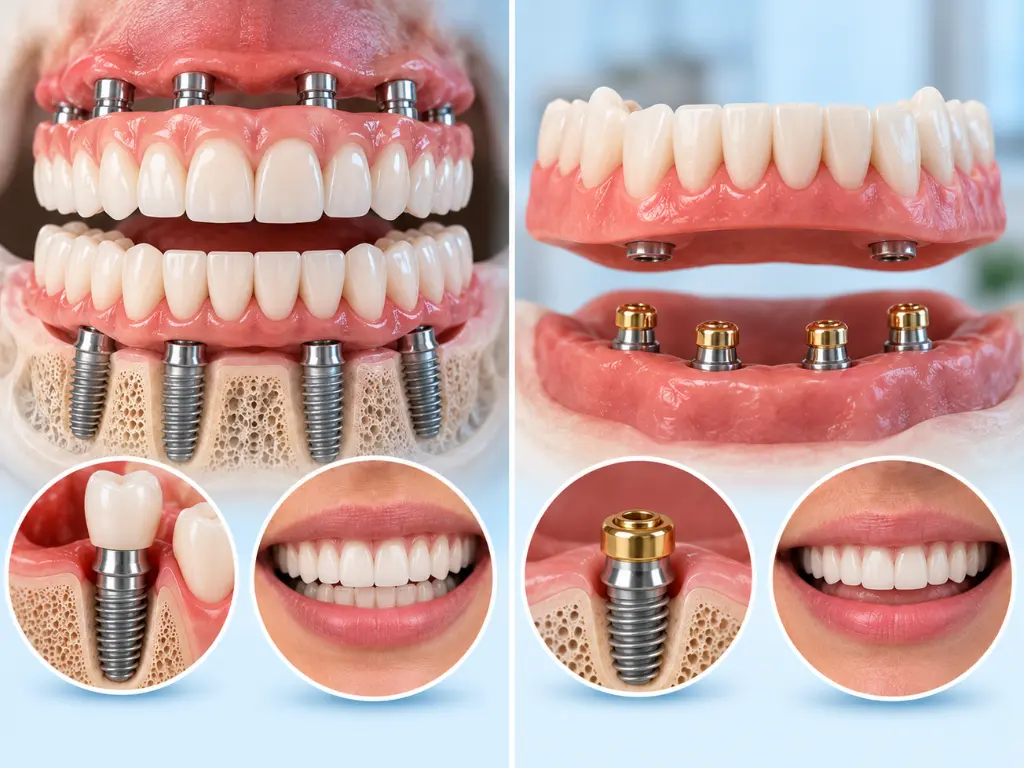
Full mouth implants cost $15,000 to $40,000 or more per arch for a fixed set of teeth, and most cases fall between $20,000 and $35,000 per arch. A full arch is held by often four to six implants, and at California in-network medians the four implant bodies alone come to $7,316 before the fixed bridge of teeth is made.
National averages from CareCredit put All-on-4 at $15,176 and All-on-6 at $29,980. All-on-4 is a Nobel Biocare treatment concept: a full arch of teeth fixed to four implants, with the back two angled to avoid the sinus or nerve.
A snap-in denture costs far less. Two lower implants with attachments and a new denture come to about $5,572 at California in-network rates. The denture clips onto the implants and comes out at night for cleaning, while a fixed arch stays in. If implants are not the right step yet, our breakdown of conventional denture costs covers the non-implant route.
Any teeth that still need removing before a full arch add extraction fees to the total.

Extra procedures move an implant quote more than the implant itself. CareCredit's national averages for the common additions are:
Bone for a graft can come from your own body, a human donor, an animal source or synthetic material, and the choice changes the fee. Grafting from your own bone costs the most, because it adds a second surgical site. If you want to be asleep or deeply relaxed for surgery, our sedation options page explains oral and IV sedation.
Ask every office one question before you sign: what happens to the cost if the implant does not fuse? Failure is uncommon, but when it happens the implant is removed, the site heals and a new implant goes in. Infection at the site, nerve injury and sinus problems with upper implants are the other complications to discuss at the consultation.
Implant prices vary between San Diego offices mainly because of what each quote includes and who places the implant. One office may quote the implant body alone; another quotes the finished tooth with scan, abutment and crown.
Experience is the other part of the price. The American Academy of Implant Dentistry, founded in 1951, credentials dentists with advanced implant training and suggests asking any dentist:
At Smiles By Design, Dr. Dan Javaheri plans and places implants in our Carmel Mountain Ranch office. He graduated from the NYU College of Dentistry and has more than 17 years in general, cosmetic and implant dentistry. Patients rate the practice 5.0 across 212 Google reviews, and one review on our homepage describes a back molar implant Dr. Javaheri placed three months earlier with a good bite and no problems since.
Most patients pay for implants with a mix of dental insurance, pre-tax HSA or FSA money and a monthly plan. Each covers a different slice of the bill.
Most dental insurance plans cover only part of implant treatment, if any. Where a plan does pay, the annual maximum is the limit that matters: ADA News reported in December 2025 that 32.8% of annual maximums sit between $1,000 and $1,500, less than half the cost of one implant.
Timing can stretch a small maximum. Placing the implant in one plan year and the crown in the next charges each stage to a different year's maximum. Take the $3,116 in-network implant and crown on a plan paying 50% after a $50 deductible: splitting the stages across two years adds $508 of benefit on a $1,000 maximum, but only $8 on a $1,500 maximum. Split the treatment when your maximum is low; on a higher maximum it barely matters.
Original Medicare does not pay for implants. Medicare.gov lists dentures and implants among the dental services it does not cover, though some Medicare Advantage plans add dental benefits.
Dental implants are a qualified medical expense, because IRS Publication 502 counts artificial teeth and the treatment of dental disease. For 2026 you can put $4,400 into a self-only HSA, $8,750 into a family HSA and $3,400 into a health FSA. On a $1,500 maximum, the $3,116 implant and crown leaves $1,616 for you to pay, which a single year's FSA covers with room to spare.
Third-party financing such as CareCredit spreads the balance into monthly payments, often $200 to $500 a month for implant treatment. Check the interest rate that applies once any promotional period ends, since that decides the real cost. Our team reviews your insurance and financing options with you at the consultation, before you commit to treatment.
A dental implant takes 3 to 12 months from extraction to final crown. The International Team for Implantology sets out the placement windows in its 2018 consensus on placement and loading protocols:
Every path includes more than 2 months of bone healing before the permanent crown goes on. Time and money move together here: the 8 to 12 month path is the one carrying a graft fee. Some patients can have a temporary tooth fitted on surgery day, so there is no visible gap while the bone heals. Our dental implant timeline guide lists every visit on each path.
The cheapest implant is usually the one placed before the bone shrinks. A 2003 study by Schropp and colleagues found the jaw ridge lost about 50% of its width within 12 months of an extraction, and a narrow ridge brings a graft fee and extra months. These steps cut the bill without cutting corners:
Choosing an implant on price alone is the false economy here. A cheaper implant that fails or a crown that chips costs more to put right than the difference you saved.
One dental implant in San Diego costs $3,000 to $6,000 with the abutment and crown, and most cases land between $3,500 and $5,000. March 2026 California in-network medians put the implant at $1,829 and the implant crown at $1,287, before the abutment, scan and any bone graft.
Dental implants are expensive because one tooth involves surgery, a titanium implant, an abutment and a lab-made crown, often with a 3D scan, an extraction or a bone graft. Each step is billed separately. The result lasts: a 2019 review found 96.4% of implants still in place after 10 years.
Affordable dental implants in San Diego come from lowering the bill, not from a cheaper implant. Use in-network insurance, split the implant and crown across two plan years, pay your share with HSA or FSA money, and ask whether a snap-in denture suits you instead of a fixed full arch.
Some dental plans pay part of implant treatment and many pay nothing. Where coverage exists, the annual maximum caps it, and ADA News found 32.8% of maximums sit between $1,000 and $1,500. Ask your insurer for a pre-treatment estimate listing codes D6010 and D6065.
Original Medicare does not cover dental implants or dentures, according to Medicare.gov. Some Medicare Advantage plans add dental benefits, so check the plan's evidence of coverage. HSA money saved before Medicare enrolment can still pay for implants afterwards.
All-on-4 implants average $15,176 per arch nationally on CareCredit's cost list, while fixed full arch treatment in San Diego runs $15,000 to $40,000 or more per arch, most often $20,000 to $35,000. Grafting, the number of implants and the bridge material set the final price.
You can pay for dental implants monthly through third-party financing such as CareCredit, often $200 to $500 a month. Check the interest rate that applies after any promotional period. HSA and FSA money can pay your share as each stage of treatment is completed.