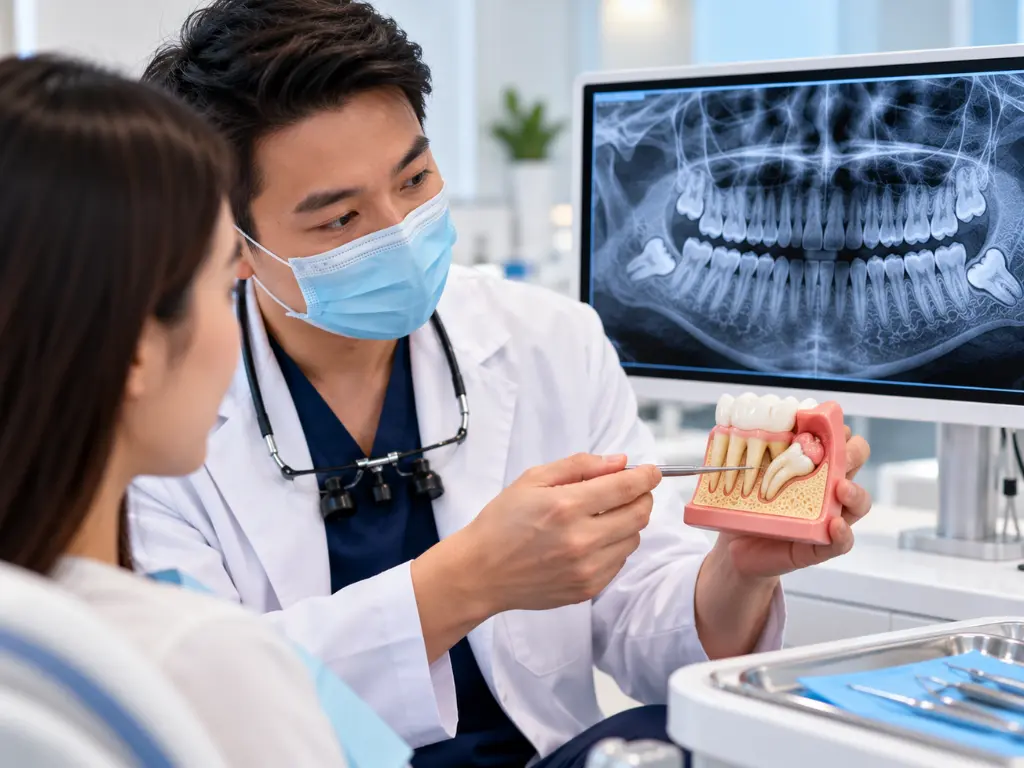


A deep teeth cleaning, also known as scaling and root planing, is typically recommended when gum disease progresses beyond gingivitis and periodontal pockets begin forming around the teeth. Unlike routine cleanings performed every six months for prevention, deep cleanings are performed as needed based on clinical findings such as pocket depth, bleeding, and bone loss. For most adults, deep cleaning is not done on a fixed schedule but rather in response to active periodontal disease. After treatment, maintenance visits every three to four months may be required to prevent recurrence. The frequency depends on disease severity, risk factors, and long-term periodontal stability.
Introduction
Routine dental cleanings are commonly recommended every six months. However, when gum inflammation progresses into deeper periodontal involvement, a standard cleaning is no longer sufficient.
A deep teeth cleaning is a therapeutic procedure designed to treat active gum disease rather than prevent it. Many patients assume it should be performed annually or at regular intervals, but that is not how periodontal therapy is structured.
At Smiles By Design Dentistry of San Diego, periodontal treatment planning is based on diagnostic measurements rather than calendar scheduling. Understanding when deep cleaning is necessary—and how often it should be repeated—requires understanding how gum disease progresses biologically.
A deep teeth cleaning, clinically known as scaling and root planing, is a non-surgical periodontal procedure designed to remove plaque and hardened calculus from beneath the gumline and smooth the root surfaces of teeth.
Unlike routine prophylaxis, which focuses on visible surfaces above the gums, deep cleaning addresses infection in periodontal pockets where bacteria accumulate below the gum margin.
It is considered therapeutic, not preventive.
Gum disease begins when plaque biofilm accumulates along the gumline. Bacterial toxins trigger inflammation, leading to gingivitis.
If untreated, inflammation extends deeper. The attachment between the gum tissue and tooth weakens, forming periodontal pockets. These pockets create a protected environment for anaerobic bacteria to thrive.
As infection persists, connective tissue fibers detach and bone resorption begins.
Deep cleaning mechanically removes bacteria and calculus from these pockets and smooths root surfaces to discourage further bacterial adherence. By reducing microbial load, inflammation can subside and tissue can reattach partially.
However, bone loss that has already occurred cannot be reversed through cleaning alone.
Deep cleaning becomes necessary when periodontal disease progresses beyond reversible gingivitis.
Risk factors include:
While plaque is the initiating factor, systemic health influences disease progression.
Clinical indicators include:
These findings indicate disease progression beyond routine cleaning capability.
Pain is not a reliable indicator. Many patients with moderate periodontal disease experience minimal discomfort.
Occasional mild bleeding due to aggressive brushing can occur in healthy individuals.
However, consistent bleeding, swelling, and pocket depth beyond 3 mm indicate pathological inflammation.
Healthy gums do not bleed easily during gentle brushing or flossing.
Distinguishing minor irritation from chronic disease requires professional assessment.
Evaluation is recommended if:
Early detection may allow non-surgical management before surgical intervention becomes necessary.
Diagnosis includes:
Pocket depth of 1–3 mm is considered healthy.
Depths of 4–5 mm suggest early periodontitis.
Depths of 6 mm or more indicate advanced disease.
Treatment frequency depends on these findings.
Treatment pathways may include:
Deep cleaning is typically the first-line treatment for moderate periodontitis.
The procedure is often performed under local anesthesia. Ultrasonic instruments and hand scalers remove hardened calculus from beneath the gumline.
Root planing smooths the root surface to discourage bacterial reattachment.
Treatment may be divided into quadrants over multiple appointments.
Mild post-treatment tenderness is common.
Tissue healing typically occurs over several weeks as inflammation decreases.
Deep cleaning is generally safe but may involve:
Failure to control plaque after treatment may lead to disease recurrence.
Deep cleaning is effective but requires maintenance.
For early to moderate periodontitis, deep cleaning can stabilize disease progression.
Success depends heavily on:
Without maintenance, periodontal pockets may deepen again.
Deep cleaning is not a one-time cure but part of a long-term management strategy.
After initial therapy, most patients enter periodontal maintenance programs.
Maintenance typically occurs every three to four months rather than every six months.
This shorter interval disrupts bacterial regrowth before destructive inflammation resumes.
Long-term stability requires collaboration between patient and dental provider.
Purpose
Routine Cleaning: Preventive
Deep Teeth Cleaning: Therapeutic
Gum Health Stage
Routine Cleaning: Healthy gums or gingivitis
Deep Teeth Cleaning: Periodontitis
Below-Gum Cleaning
Routine Cleaning: Minimal
Deep Teeth Cleaning: Extensive
Anesthesia Required
Routine Cleaning: No
Deep Teeth Cleaning: Often required
Frequency
Routine Cleaning: Every 6 months
Deep Teeth Cleaning: As needed
Maintenance After Treatment
Routine Cleaning: Standard recall visits
Deep Teeth Cleaning: 3–4 month periodontal maintenance
Deep cleaning is not required annually for everyone.
It does not replace daily brushing and flossing.
It does not permanently cure advanced periodontal disease.
It is not simply a “more thorough” regular cleaning.
Clarity reduces unnecessary procedures and delayed care.
How often should adults get a deep cleaning?
Only when periodontal disease is present and based on clinical findings—not on a fixed schedule.
Is deep cleaning painful?
Local anesthesia is typically used to minimize discomfort.
Can gum disease return after deep cleaning?
Yes, if maintenance and home care are inconsistent.
Do I need deep cleaning every year?
Not unless clinical measurements indicate recurrent disease.
Dr. Dan Javaheri, a graduate of the New York University College of Dentistry, emphasizes that deep teeth cleaning should be recommended based on objective periodontal measurements rather than routine scheduling. With advanced training in restorative and implant dentistry and certification through the California Academy of Implant Dentistry, he integrates periodontal assessment into comprehensive treatment planning. Research involvement associated with the National Institutes of Health and UC Davis Medical Center supports evidence-based inflammatory management. At Smiles By Design Dentistry of San Diego, periodontal stability is monitored systematically to reduce long-term structural compromise.