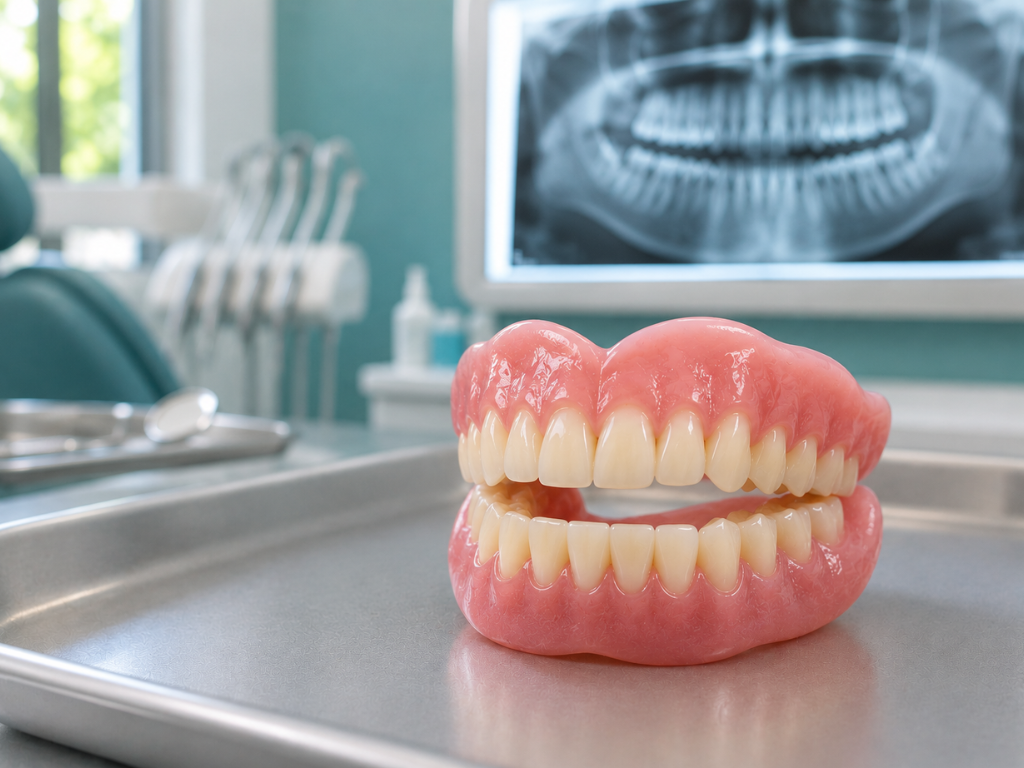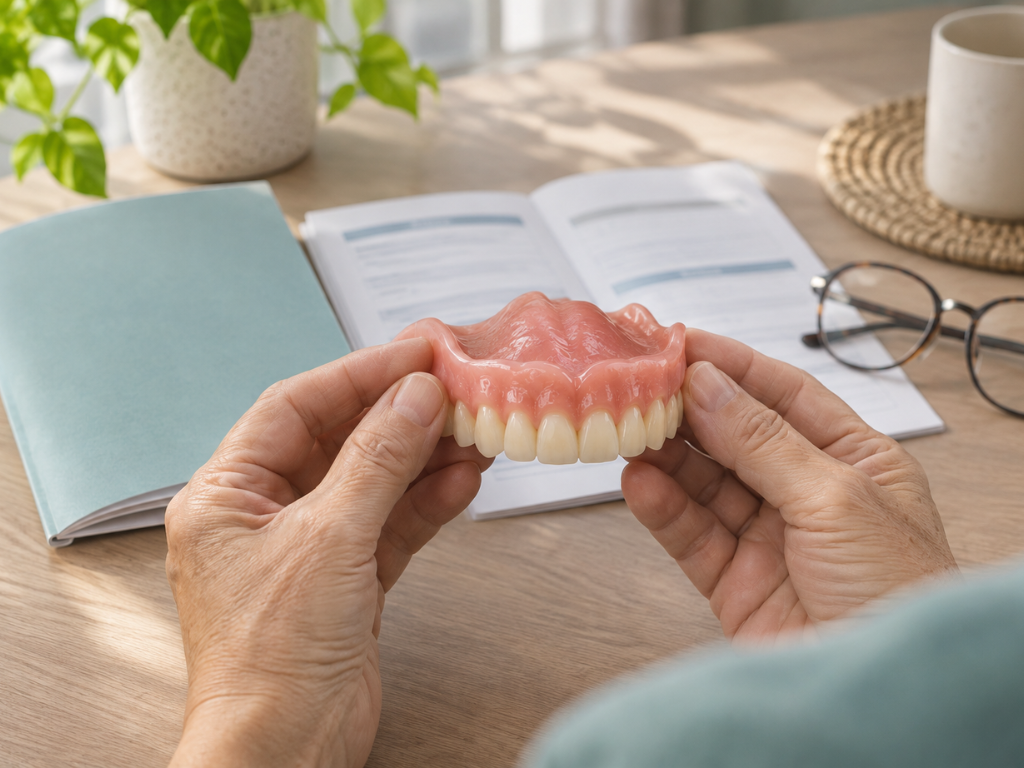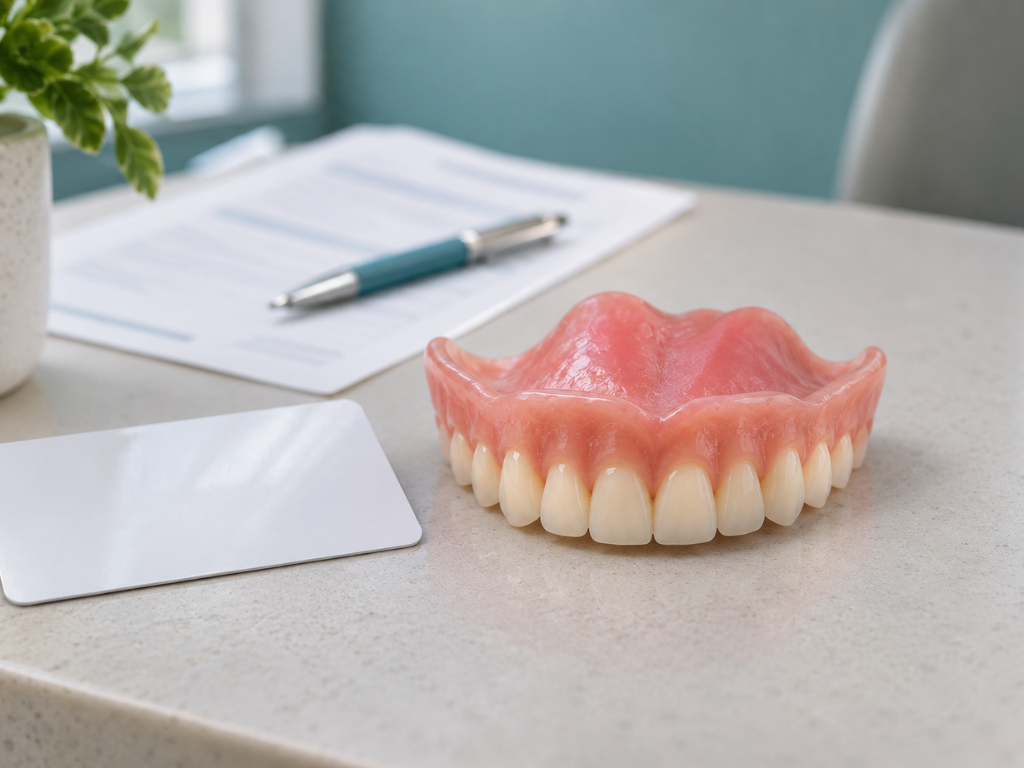
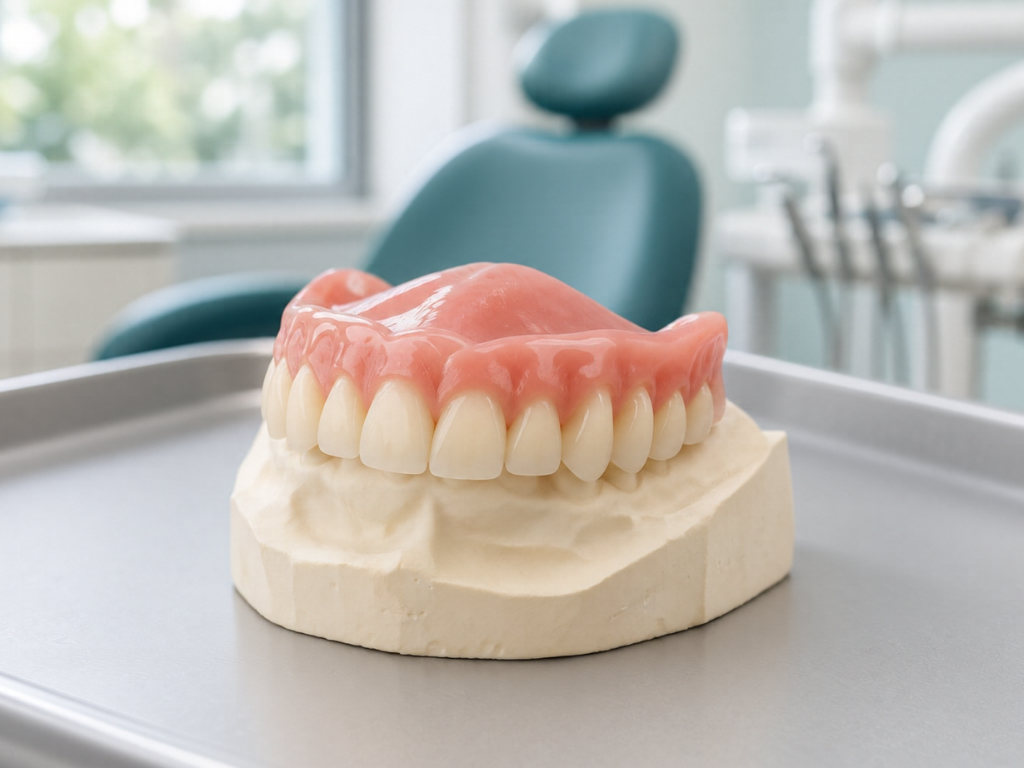


Immediate dentures are dentures placed the same day your teeth are pulled, so you leave with teeth and not a gap. They suit you if your remaining teeth can't be saved and you can't go months without teeth, but they're a first step, with relines to follow.
Our dental implant options page covers the implant-backed alternatives. Smiles By Design Dentistry of San Diego in Carmel Mountain Ranch fits both.
They're complete or partial dentures made before your extractions and placed right after them. We take impressions before extraction, so the lab builds your denture on our estimate of how your gums will heal. A conventional denture is made after your gums have healed for at least six to eight weeks. Of all the types of dentures, this is the one built for same-day placement.
People also call them temporary dentures, and that's usually fair, because this denture gets you through the healing period and then needs a hard reline or replacing. It's still made by a lab for your mouth and adjusted as you heal. A snap-on kit sold online is a different thing, and it won't do this job.
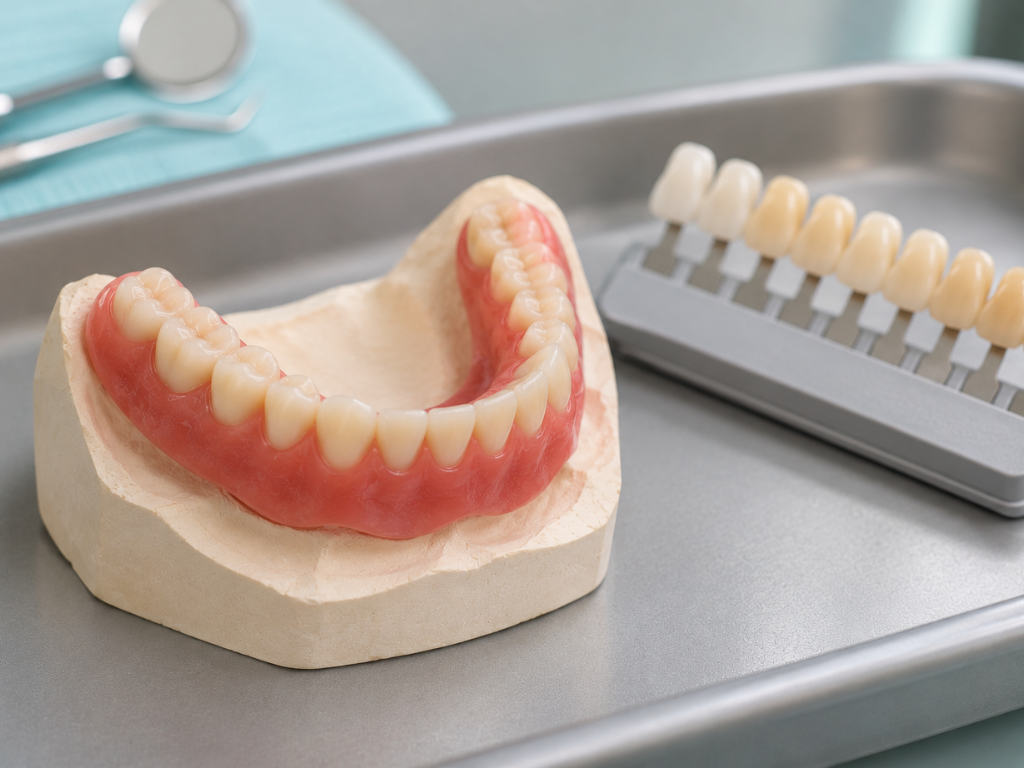
Get immediate dentures if going without teeth isn't an option for you, and wait if you can live with a gap and want a better first fit. We'll be straight with you: an immediate denture gives instant relief, but it isn't the ideal way to get teeth, because it's made on an estimate.
Why people choose them:
What you give up:
If you deal with the public, or going without teeth would keep you at home, choose immediate dentures. If you can stay home for a few months and your budget is tight, waiting for a conventional denture skips the second step. If you already wear a good partial, ask whether teeth can be added to it on extraction day, because that can save you a new denture.
If you're still weighing pulling all teeth for dentures, settle that first, because a healthy tooth is worth keeping under a partial. Some people aren't good candidates at all because of their general health or the condition of their mouth.
To give you a straight answer, we'd need to examine your teeth and gums, take X-rays and go through your medical history. Bring any denture you wear now. Our dentures in San Diego page covers the options we'd weigh with you.
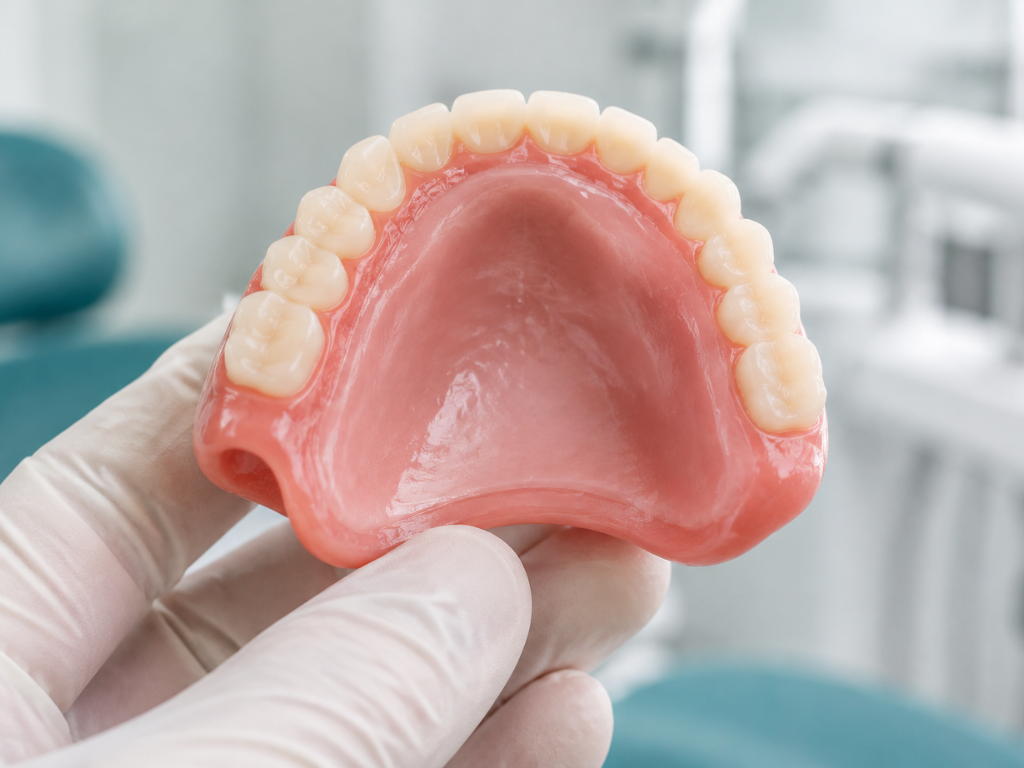
Expect several visits over a few weeks before extraction day, so this isn't a walk-in job. We take impressions and bite records, choose your teeth and check the back teeth in a try-in. Your own front teeth are still in place at that stage, so bring a photo if you want your smile copied or changed.
If you're losing every tooth in an arch, the back teeth often come out first and heal for six to eight weeks, which gives a better-fitting denture. You keep your front teeth during that time, so nobody sees a gap.
On extraction day, your remaining teeth come out and the denture goes in during the same visit. If you're nervous or having several teeth removed, ask about our sedation options, which include nitrous oxide, oral sedation and IV sedation. You'll need someone to take you home after oral or IV sedation.
You'll be numb for the extractions, so the soreness comes afterward, with swelling for a few days and sore spots as the denture settles. Keep it in for the first 24 hours, because that helps control bleeding and swelling. Slight bleeding can last two to three days, and gentle biting pressure on the denture helps it clot.
Sore spots are normal, and we fix them at adjustment visits. If one gets bad, wear the denture for 24 hours before your appointment, because that shows us exactly where it's rubbing. Don't file or adjust the denture yourself, because you can't undo it.
By about three weeks, bone and gum loss leaves real space under the denture, so it feels loose and rubs. You'll need a soft reline within a few weeks to a month, often with a tissue conditioner, a cushioned lining that tightens the fit while you heal. Our immediate denture aftercare page has the day-by-day instructions.
The denture may feel bulky for weeks, and speaking and eating naturally can take months. Call us the same day if you notice any of these:
Trouble breathing after a medication means the ER right away.
Plan on about six months before the denture needs a permanent fix. Public clinics such as NHS Lothian warn that you may need a new set after around 6 to 12 months, so don't treat this denture as your last one. The reason is bone resorption, the shrinking of the bone that once held your teeth, which is fastest in those early months.
Around six months, you choose between a hard reline and a new denture. A hard reline adds a firm new lining, and it turns your immediate denture into a standard one. It's often left at the lab overnight, so plan for a night without it. A new denture is made on your healed gums, and your immediate denture becomes your spare.
If you like how the teeth look and your bite feels right, a hard reline is usually enough. If the teeth look wrong, the bite is off, or you can't afford a day without teeth, we'd pay for the new denture.
The mistake is skipping this step because you've got used to the wobble. Wearing a loose denture for too long can cause serious bone loss, and that makes every denture after it harder to fit.
An immediate denture averages about $2,180 nationally, and that's before extractions and what comes later. Extractions average about $177 for a simple one and $363 for a surgical one, per tooth. These are market figures, not our fees, and our breakdown of immediate denture cost shows what's behind them.
The six-month step is the part people leave out of their budget. Fee guides put a hard reline at roughly $280 to $900 per arch, while a new conventional denture runs about $1,240 per arch at California in-network rates. We charge for the hard reline or second denture separately, so ask any office the same question.
Before you compare two quotes, ask what each one includes: adjustment visits, the soft reline, the six-month step, extractions and sedation. A low price that leaves these out can cost you more by month 12.
If you're asking does dental insurance cover dentures, the answer is usually yes as a major service. Check before your extractions whether your plan will pay for the immediate denture and the final one, because the first can start a 5-year limit. On a Covered California dental HMO, the 2026 adult copay is $400 per immediate denture and $120 for a lab reline.
If your teeth can't be saved and you can't go without teeth, choose immediate dentures and budget for the six-month step from the start. If you have healthy teeth left, keep them. If you can wait through healing, a conventional denture saves you a step. To confirm which fits you, we need to examine your teeth and gums and see your X-rays.
Book a free consultation at Smiles By Design Dentistry in Carmel Mountain Ranch, or call (858) 485-5552.
Only a few minutes at a time during the first few days, because swelling around the sockets can stop the denture going back in. After the first 24 hours, take it out to clean it and rinse your mouth, then replace it. Smiles By Design will tell you when to leave it out overnight.
Yes, but start with soft foods and small portions. Cut food into small pieces, chew toward the sides, and avoid biting with your front teeth until you've got control of the denture. Chewy, crunchy, sticky and hard foods can wait. Even a settled denture has only 20 to 25% of the chewing power of natural teeth.
They look like natural teeth, usually in acrylic, and they're matched to your own teeth while those are still in your mouth. The lab can copy the shape, color and arrangement, or change them if you ask. You'll see the finished front teeth on extraction day, so Smiles By Design wants your preferences settled at the try-in.
A little can help as the denture loosens, but ask us first while your sockets are healing. If you need more each week, the denture no longer matches your gums and it's time for a reline. Adhesive won't fix that. Smiles By Design can check the fit at your next adjustment visit.