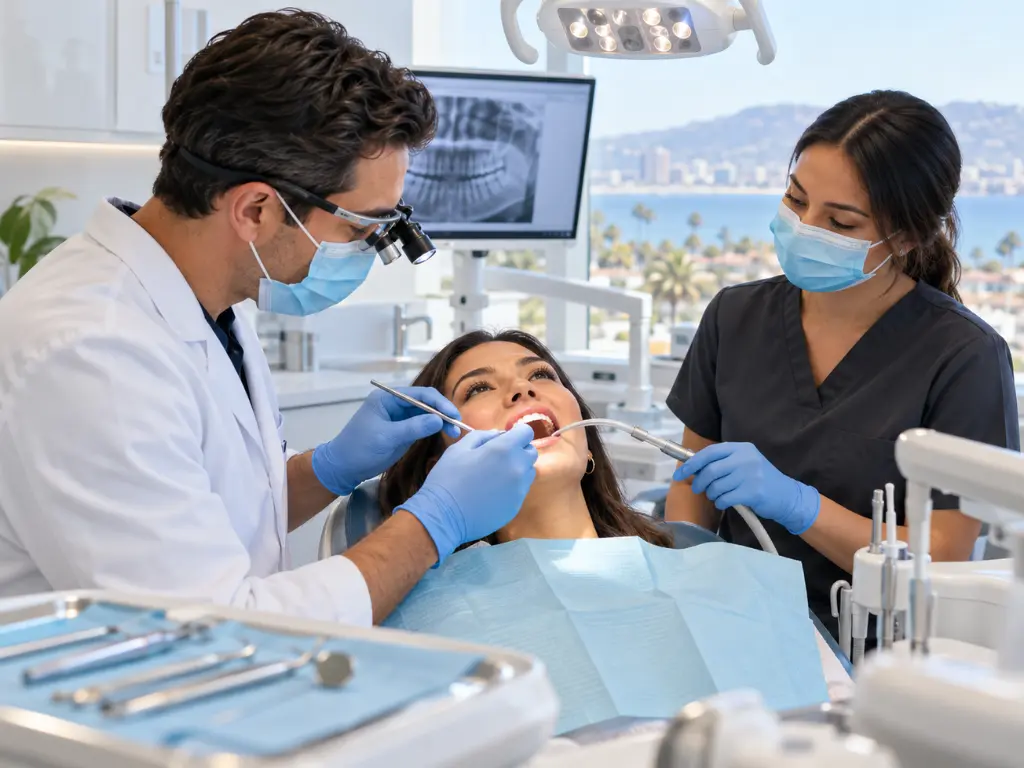


Wisdom teeth removal means taking out one or more third molars, the last teeth to come through, usually between ages 17 and 25. You need one out when it is impacted, infected, decayed or pushing on the molar beside it. A wisdom tooth that has come through fully, stays clean and doesn’t hurt can stay where it is, with X-rays at your check-ups.
Most extractions take under 40 minutes with local anaesthetic. Dentists add sedation for impacted teeth or nervous patients, and most people feel normal again within 1 to 2 weeks. For pain, the American Dental Association’s 2024 guideline puts ibuprofen with acetaminophen ahead of opioids. This guide is for San Diego patients and parents deciding whether to go ahead, when, and who should do it. It follows the same evidence we use at our Carmel Mountain Ranch practice.
Wisdom teeth are your third molars, the four teeth right at the back of the mouth. The American Association of Oral and Maxillofacial Surgeons (AAOMS) puts their arrival between 17 and 25, years after the second molars have taken the space. Most people have them removed because the jaw has run out of room for them to come in straight.
Cleaning causes the rest of the trouble. A wisdom tooth that only half breaks through leaves a flap of gum that traps food and bacteria, and your toothbrush can’t reach behind it. An AAOMS study of more than 300 patients aged 14 to 45 found gum disease around upright third molars as often as around impacted ones, because patients couldn’t keep them clean.
A 2007 analysis in the American Journal of Public Health estimated that 5 million Americans have about 10 million wisdom teeth taken out every year.
For each tooth, your dentist needs to know two things: is it healthy and cleanable, and is it leaving the second molar alone? An exam and a panoramic X-ray answer both. The X-ray shows all four third molars, their roots and the nerve canal in the lower jaw in one image.
Your wisdom tooth should come out when it is already causing disease, or sits where disease is close to certain. Any one of these findings is reason enough:
If your tooth shows none of these, the evidence splits. A 2020 Cochrane systematic review by Ghaeminia and colleagues found too little evidence to support or rule out removing impacted wisdom teeth that cause no symptoms and no disease. The NHS leaves those teeth in place and monitors them. AAOMS now offers a range, from removal to a monitored retention plan. “Not everybody needs to have their wisdom teeth out,” said Dr. Raymond White Jr., principal investigator of AAOMS-funded third molar research.
We sit between the two camps. If your wisdom tooth has healthy gum, no pocket behind the second molar and a clean X-ray, we leave it and re-check it with X-rays at your check-ups. If it has a gum flap that traps food, we recommend taking it out even when it doesn’t hurt, because the AAOMS data shows disease builds up around teeth patients can’t clean.
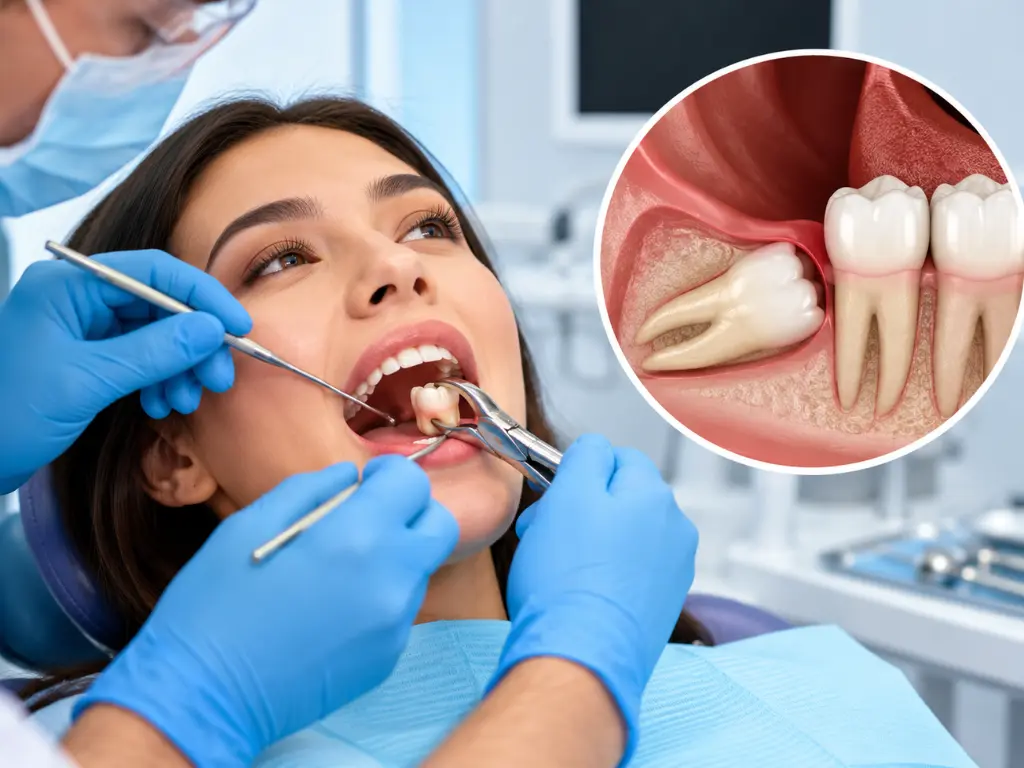
Your dentist takes out an erupted wisdom tooth like any other molar, often in a few minutes. An impacted tooth needs minor surgery. The NHS describes it in four steps: the surgeon opens the gum, widens the socket, lifts the tooth out whole or in 2 or 3 pieces, then closes the gum with dissolvable stitches.
The deeper the tooth sits, the bigger the surgery and the fee. CareCredit’s 2024 US averages show the jump at each level:
The angle matters as much as the depth. A tooth lying sideways against the second molar’s root takes more work to free than one standing upright. Lower wisdom teeth also sit above the inferior alveolar nerve, which gives feeling to your lower lip and chin. A review in the Journal of Oral & Maxillofacial Research put nerve injury after lower wisdom tooth removal at 0.35% to 8.4%. Most of those injuries healed, and permanent damage was very rare. The authors named horizontal impaction and age over 24 as risk factors.
If your panoramic X-ray shows a root overlapping the nerve canal, a 3D cone-beam CT (CBCT) scan tells your dentist whether the two touch.
A general dentist removes erupted wisdom teeth and many straightforward impacted ones. An oral and maxillofacial surgeon takes on deep bony impactions, roots that sit on the nerve canal and cases that need general anaesthesia. According to AAOMS, oral surgeons complete 4 to 6 years of hospital-based surgical residency after dental school, so the hardest cases belong with them.
At Smiles By Design, Dr. Dan Javaheri removes wisdom teeth in our office. One review on our homepage describes a wisdom tooth extraction with Dr. Javaheri and no swelling or pain afterwards, though recovery varies from patient to patient.
Dr. Javaheri refers two kinds of case to an oral and maxillofacial surgeon: a lower tooth with roots wrapped around the nerve canal, and a medical history that calls for hospital-level anaesthesia.
One evaluation should settle both of your questions. Does this tooth need to come out, and who should remove it? Before you book anywhere, ask which impaction level your tooth is and which sedation permit the provider holds from the Dental Board of California.
According to the NHS, the extraction takes a few minutes for an erupted tooth and up to about 40 minutes for a difficult one. Check-in, numbing, any sedation and a short rest afterwards add to that.
Lower wisdom teeth take longer than upper ones. The bone in the lower jaw is denser and the nerve runs beneath the roots, so your dentist takes more time around it.
Most people stay awake for wisdom teeth removal. Local anaesthetic numbs the area, and you can add nitrous oxide, oral sedation or IV sedation if you want to feel relaxed. Oral surgeons keep general anaesthesia, where you are fully unconscious, for complex surgical cases.
Local anaesthetic on its own is an injection beside the tooth. You stay awake and can drive yourself home. It suits a single erupted tooth.
Nitrous oxide (laughing gas) comes through a mask over your nose. You stay awake but relaxed, and it wears off fast, though you should check with the team before you drive. It works for mild nerves and short visits.
Oral sedation is a prescribed tablet you take before the visit. You’ll feel drowsy but still respond, so arrange a driver. It suits moderate anxiety and longer appointments.
IV sedation goes in through a vein while the team monitors your vital signs. You’ll be deeply relaxed, and the NHS advises no driving for 24 hours afterwards. It suits impacted lower teeth, or all four teeth in one visit.
General anaesthesia puts you fully to sleep, usually at an oral surgeon’s practice for complex surgery. The NHS advises no driving for 48 hours afterwards.
California law sets who can give each level. Since 1 January 2022, Senate Bill 501 has required a Moderate Sedation permit from the Dental Board of California, replacing the older Conscious Sedation permit. Deep sedation and general anaesthesia need a separate General Anesthesia permit. You can check any California dentist’s permits on the Dental Board’s online licence lookup.
For a single erupted tooth, local anaesthetic is enough. For impacted lower teeth, or all four in one visit, we recommend IV sedation because it makes a long appointment easier for you and for the dentist. Our sedation dentistry options page covers monitoring and how to prepare.
The NHS says most people go back to school or work the day after a simple extraction, or within 1 to 3 days after surgical removal or a general anaesthetic. Soreness, stiffness and bruising settle within 2 weeks. The first 24 hours count the most, because that’s when the blood clot forms over the socket.
In the first hour you’ll have some oozing and a numb lip and cheek. Bite on gauze for 30 minutes without changing it. If the bleeding continues, repeat with fresh gauze or a damp tea bag.
Numbness lasts several hours on day 1, and your saliva will look pink. Ice your cheek 15 minutes on, 15 minutes off, and rest. For 24 hours, skip rinsing, spitting, straws and smoking, and leave brushing for the first 8 hours.
By days 2 and 3, pain and swelling start to ease. Start warm salt water rinses (½ teaspoon salt and ½ teaspoon baking soda in 8 oz warm water), stick to soft food and avoid alcohol for 48 hours.
Between days 3 and 5 your jaw may still feel stiff, but most people are back to their routine. Brush the surgical site with light pressure from day 3, and call us if the pain gets worse instead of better.
From day 7 to day 14 the bruising fades and dissolvable stitches disappear. Keep your follow-up or stitch check, and bring crunchy food back as you feel ready.
The American Dental Association’s 2024 guideline makes NSAIDs the first choice for pain after extractions in anyone aged 12 or older. For a simple extraction, that means ibuprofen 400 mg or naproxen sodium 440 mg, on its own or with acetaminophen 500 mg. Dentists save opioids for pain NSAIDs can’t control, and rarely prescribe them beyond 3 days. Take your first dose before the numbness wears off, and follow the dose on your own instructions.
Dry socket (alveolar osteitis) happens when the blood clot breaks down or falls out and leaves bone exposed. StatPearls reports it in under 5% of cases in large studies, rising to around 30% for lower wisdom teeth across several systematic reviews. Smoking and oral contraceptives raise your risk.
You’ll know it by pain that gets worse a few days after surgery, when it should be easing. Many people also notice a bad taste and a socket that looks empty. Dry socket delays healing but it isn’t an infection, and a medicated dressing at our office brings the pain down.
Eat soft foods for the first 2 days, then go back to normal meals when you’re ready. Our soft-food recovery guide lists what works. Leave nuts, seeds and crunchy food until the sockets close.
Call us if pressure doesn’t stop the bleeding or your medication doesn’t control the pain. The same goes for a fever, a reaction to a medication, swelling that grows after day 3, or a lip, chin or tongue that stays numb after surgery day. We offer same-day emergency appointments for problems like these.
Based on CareCredit’s 2024 cost data, wisdom teeth removal in the US averages $363 per tooth and $835 for a complicated impacted tooth. All four average $2,685, or $3,340 if all four are impacted. Most PPO plans file extractions as basic oral surgery and pay around 80% after the deductible, until you reach the annual maximum.
Sedation costs extra. CareCredit’s 2024 averages are $349 for dental sedation and $639 for general anaesthesia.
Plans differ. Delta Dental PPO summaries for public employers in California and Colorado cover oral surgery at 80%, while one Delta Dental of Virginia plan files surgical extractions under major services at 25%. Annual maximums on the plans we reviewed ran from $1,200 to $2,000. One Delta Dental of Oregon summary covers IV sedation only when the dentist gives it alongside covered oral surgery in their own office.
Most families lose money at the annual maximum. Say you need four impacted teeth out at the $3,340 average, on a plan with 80% coverage, a $50 deductible and a $1,500 annual maximum.
Book all four in one benefit year and the plan’s 80% share comes to $2,632. The plan stops paying at $1,500, so you pay $1,840. Book two in December and two in January instead, and the plan pays $1,296 each year while you pay $374, or $748 in total.
Splitting the treatment across two benefit years saves you $1,092, or 59%. It only works if no tooth is infected. If you have an active pericoronitis flare, that tooth comes out now, not in January.
We accept most insurance plans and offer financing. Ask your insurer for a pre-treatment estimate before surgery so you know your share up front.
Your dentist should make a separate call on each wisdom tooth. A tooth with a gum flap, decay or a pocket behind the second molar should come out, best before 25 while the roots are short. A healthy tooth you can clean can stay, with X-rays to watch it. Most extractions take under 40 minutes with local anaesthetic and most people are back at work within 3 days. If you need four impacted teeth out, spreading them across two benefit years can cut your bill by more than half.
Book a wisdom teeth evaluation with Dr. Javaheri at Smiles By Design Dentistry in Carmel Mountain Ranch. Book your evaluation or call (858) 485-5552.
The late teens to early 20s is the best age for wisdom teeth removal, while the roots are only partly formed. AAOMS notes that removal gets more complicated once the roots finish forming, and a Journal of Oral & Maxillofacial Research review lists age over 24 as a risk factor for nerve injury. Adults in their 30s and older still have wisdom teeth out, with more planning.
If all four need removal, yes. One appointment means one sedation fee and one recovery, so you only take one block of days off. You don’t need to lose a healthy, fully erupted tooth because the others are going. The 2020 Cochrane review found no proven benefit from removing wisdom teeth that cause no symptoms and no disease.
For the first 2 days, eat soft, cool food with a spoon: yoghurt, eggs, mashed potato, lukewarm soup and smoothies. Skip straws and smoking for at least 24 hours, because suction can pull the clot out. Avoid alcohol for 48 hours, and save nuts, seeds and chips until the sockets have closed.
Plan one day off after a simple extraction under local anaesthetic, and 1 to 3 days after a difficult extraction or general anaesthetic, according to the NHS. Book the removal before a weekend or school break. Skip hard exercise for the rest of surgery day, and don’t drive for 24 hours after IV sedation.