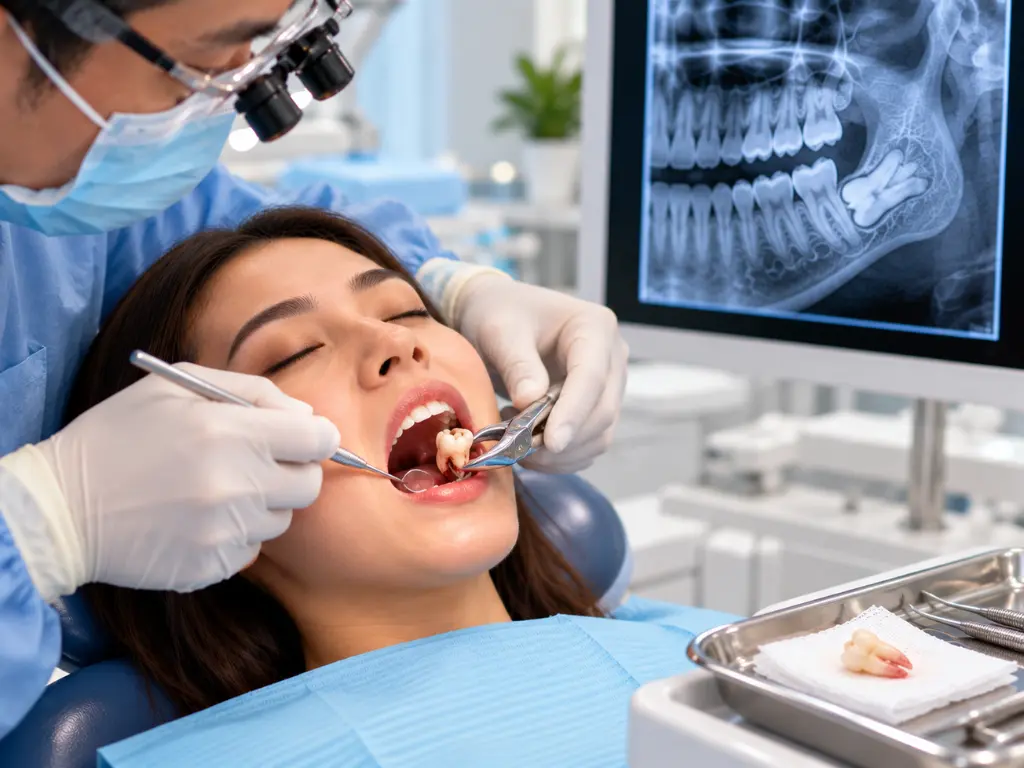


You’ll need 1 to 2 weeks to recover from wisdom teeth removal. Swelling and pain peak on day 2 or 3 and ease each day after that. Most people go back to work within 1 to 3 days and eat normally again after about a week. If your pain gets worse after day 3 instead of better, call your dentist, because that timing matches dry socket.
The healing starts with a blood clot that forms in each socket on surgery day. For pain, the American Dental Association’s 2024 guideline puts ibuprofen-based relief first. We built this schedule for patients of our family dentistry in Carmel Mountain Ranch.
For the first 24 hours, your job is to protect the blood clot. Days 2 and 3 bring the worst swelling and soreness, and from day 4 each day should feel better than the one before. We put this schedule together from our extraction aftercare instructions and two NHS hospital oral surgery protocols, from Royal United Hospitals Bath and Hull University Teaching Hospitals.
Bite on the gauze for 30 minutes without changing it. If you’re still bleeding, swap to fresh gauze or a damp tea bag for another 30 minutes. Take your first pain dose before the local anaesthetic wears off, since the numbness lasts several hours. Ice your cheek 15 minutes on and 15 minutes off. Leave brushing for 8 hours and chew on the other side. Don’t rinse, spit, smoke or use a straw.
Pink saliva is normal for 24 to 48 hours, and the swelling is still building. Once 24 hours have passed, start warm salt water rinses with ½ teaspoon salt and ½ teaspoon baking soda in 8 ounces of warm water. Brush your other teeth with a soft touch.
The Bath protocol puts the peak of swelling and pain here, and your jaw will feel stiff. Stay on soft food and rinse four times a day. Avoid alcohol for the first 48 hours.
The swelling starts to go down and the pain eases a little more each day. From day 3 you can brush close to the sockets, with light pressure. Day 5 closes the dry socket window, so keep track of whether your pain is rising or falling.
Most people start moving from soft food back towards normal meals. You should be able to open your mouth fully again at around one week.
For most people the swelling has gone by now. The Bath protocol says dissolvable stitches drop out between days 7 and 10. Hull’s protocol says some take up to 3 weeks and others fall out within a couple of days, so a loose stitch on day 3 is nothing to worry about.
Any bruising on your cheek fades within 2 weeks. The NHS gives soreness and stiffness up to 2 weeks to settle in full.
According to the Royal United Hospitals Bath oral surgery protocol, swelling and pain peak on day 2 or 3 and improve over 7 to 10 days. Facial bruising can take up to 2 weeks to clear.
Use ice on the first day, while the swelling is still building. Our protocol uses 15 minutes on and 15 minutes off for the rest of surgery day.
The American Dental Association’s February 2024 guideline makes NSAIDs, alone or with acetaminophen, the first choice after extractions for anyone aged 12 or older. For a simple extraction, the guideline gives ibuprofen 400 mg or naproxen sodium 440 mg as examples, on their own or with acetaminophen 500 mg. Dentists save opioids for pain that NSAIDs can’t control, and rarely prescribe them beyond 3 days.
“We hope this clinical practice guideline will reduce the risk of opioid addiction, overdose and diversion,” said Dr. Marta Sokolowska of the FDA’s Center for Drug Evaluation and Research, which funded the work.
Start your pain relief early. Take the first dose while you’re still numb, as our aftercare sheet tells you to, then stick to the schedule on your instructions through day 3. Take tablets with food to avoid nausea, and skip alcohol while you’re on prescription pain medication.
Keep track of the direction of your pain. Normal pain climbs to day 2 or 3 and then falls. If it starts climbing again after day 3, call us. The warning signs section below covers what to look for.
Eat soft, cool food for the first 2 days, add soft cooked food from about day 3, and go back to normal meals after about a week, as your jaw allows. Our aftercare instructions call for soft foods for the first 2 days and plenty of water. A Hull University Teaching Hospitals protocol adds one more rule: no hot food or drink for the first 6 hours, because the numbness stops you feeling the heat.
Use this as your food plan:
Hold off on nuts, seeds, popcorn, chips and crusty bread. They break into small, sharp pieces that lodge in a lower socket, so leave them until the sockets close and the area stops feeling tender. Very hot drinks and spicy food will sting the wound. Our recovery diet guide lists more options for each stage.
Eat something soft before each pain dose. Our aftercare sheet names pain tablets on an empty stomach as the most common cause of nausea after surgery.
The Hull University Teaching Hospitals oral surgery unit tells patients to wait 7 days before smoking after wisdom teeth removal. Skip straws for at least the first 3 days. Both create suction that can pull the blood clot out of the socket, and the chemicals in cigarette smoke slow healing too.
A 2022 systematic review in Dentistry Journal pooled 11 studies and 10,195 patients. It found dry socket in 13.2% of smokers against 3.8% of non-smokers, more than three times the odds. StatPearls places dry socket symptoms between day 1 and day 5 after extraction, so the first week counts the most.
Vaping carries the same risk. A 2024 scoping review by Putra and colleagues in Majalah Biomorfologi concluded that e-cigarettes raise dry socket risk through the inhaling motion and through nicotine and carbon monoxide. Researchers have less evidence on vaping than on cigarettes, and most of it comes from how clots break down, but you create the same suction either way. Treat your vape like a cigarette.
For drinks, use a cup, and eat smoothies with a spoon for at least the first 3 days. Our aftercare sheet warns against sucking through a straw “for the next few days, and especially the first 24 hours”.
If you smoke, plan how you’ll stop before surgery day. A nicotine patch gives you nicotine without the suction. Ask your physician whether a patch suits you for that week.
The NHS says most people go back to work or school the day after a simple extraction, and within 1 to 3 days after a difficult extraction or general anaesthetic. The Bath protocol puts the average at 3 to 5 days off after surgical removal, depending on the job.
Sedation decides when you can drive. The NHS advises no driving for 24 hours after a sedative injection and 48 hours after a general anaesthetic. If you have oral or IV sedation at our office, you’ll need someone to drive you home.
Your job decides the rest. You can manage a desk job, or a school day with soft lunches, from day 1 or 2. If your work involves heavy lifting or long stretches of talking, you’ll find it easier from day 4, once the swelling has peaked.
Hold off on exercise until the bleeding stops. Our protocol asks you to rest for the rest of surgery day, because lower blood pressure means less bleeding, and Hull’s protocol rules out vigorous exercise for the first 24 hours. We go further for heavy lifting and hard running and ask you to wait until day 4, when the swelling is past its peak.
Leave contact sports until your jaw opens fully and chewing feels comfortable, usually about a week. Go back wearing a custom sports mouthguard, since the NHS gives jaw soreness and stiffness up to 2 weeks to settle.
Call your dentist if your pain gets worse after day 3, or if 30 minutes of firm pressure doesn’t stop the bleeding. A fever, or swelling that grows after day 3, also needs a call. These are the main signs of dry socket or infection. Our aftercare sheet lists them as uncontrollable pain, excessive bleeding, marked fever, warm swelling a few days after surgery, and reactions to medication.
Dry socket pain starts between day 1 and day 5 and spreads out from the socket. Painkillers don’t touch it much, and it often comes with bad breath. StatPearls reports it in under 5% of extractions in large studies and around 30% of lower wisdom tooth extractions. Dry socket delays healing but it isn’t an infection, and a medicated dressing at our office brings the pain down.
Call us about numbness too. If your lip, chin or tongue stays numb after surgery day, a nerve next to the socket may be irritated. A review in the Journal of Oral & Maxillofacial Research put inferior alveolar nerve injury after lower third molar removal at 0.35% to 8.4%, and most cases were temporary. Our aftercare sheet notes that some tingling lasts 6 weeks or longer.
If you have trouble breathing or swallowing, go straight to a hospital emergency room. For anything else, our guide to what counts as a dental emergency helps you judge how urgent it is, and we keep same-day emergency visits for problems like these. We’re open Monday to Thursday 8:30 am to 5:30 pm and Friday 7:30 am to 2:00 pm.
Jaw stiffness that lasts past 2 weeks is a separate issue. If the joint in front of your ear clicks or aches after the sockets have healed, book an exam.

You’ll learn more from the direction of your pain than from how sore you feel on any one day. Pain and swelling that build to day 2 or 3 and then fall mean you’re healing as expected. Pain that rises again after day 3, inside the day 1 to 5 dry socket window, calls for a same-day phone call. For the first week, protect the clot by staying off cigarettes, vapes and straws.
Planning your wisdom teeth removal, or worried about how you’re healing after one? Book a visit with Smiles By Design Dentistry in Carmel Mountain Ranch, or call (858) 485-5552.
Most people recover from wisdom teeth removal in 1 to 2 weeks. According to the Royal United Hospitals Bath oral surgery protocol, swelling and pain peak on day 2 or 3 and settle over 7 to 10 days, and bruising clears within 2 weeks. The NHS gives soreness and jaw stiffness up to 2 weeks to settle.
You can brush 8 hours after wisdom teeth removal, as long as you avoid the surgical area. Our aftercare instructions ask you to keep the brush away from the sockets for the first 3 days, then brush near them with light pressure. Start warm salt water rinses after 24 hours, with ½ teaspoon salt in 8 ounces of water.
Yes, once the numbness wears off, as long as the coffee is warm rather than hot and you drink it from a cup. The Hull University Teaching Hospitals oral surgery unit advises no hot food or drink for the first 6 hours. If you prefer iced coffee, drink it without a straw for the first 3 days.
Yes. Most stitches are dissolvable, so they come out on their own. The Royal United Hospitals Bath protocol says they dissolve and drop out after 7 to 10 days. The Hull University Teaching Hospitals protocol says some take up to 3 weeks and others fall out within a couple of days.