

Your child should first see a dentist when the first tooth appears, and no later than their first birthday, as the American Academy of Pediatric Dentistry recommends. Our children's dentist in San Diego sees babies from that first tooth. This blog will walk you through the first dental visit age, what happens and how to prepare.
The first dental visit should happen when the first baby tooth breaks through, and no later than the first birthday. The American Academy of Pediatric Dentistry (AAPD) and the American Dental Association (ADA) give the same advice, and the ADA describes it as a routine checkup for a baby's teeth, much like a visit to the doctor.
Most babies get their first tooth at around 6 months, usually a lower front tooth, so for most families the first visit falls between 6 and 12 months. Babies are born with all 20 baby teeth already in the jaw, and most have come through by age 3.
If your child is past their first birthday and has not been yet, book now. A first visit at 2 or 3 does the same job: it checks for early decay, gives you a home care plan and lets your child get used to the dentist. Children who start later sometimes need a little more time to settle, which is one reason to book as soon as you can.
A first visit at age 1 can seem early for a mouth with a handful of teeth. There are five good reasons for it.
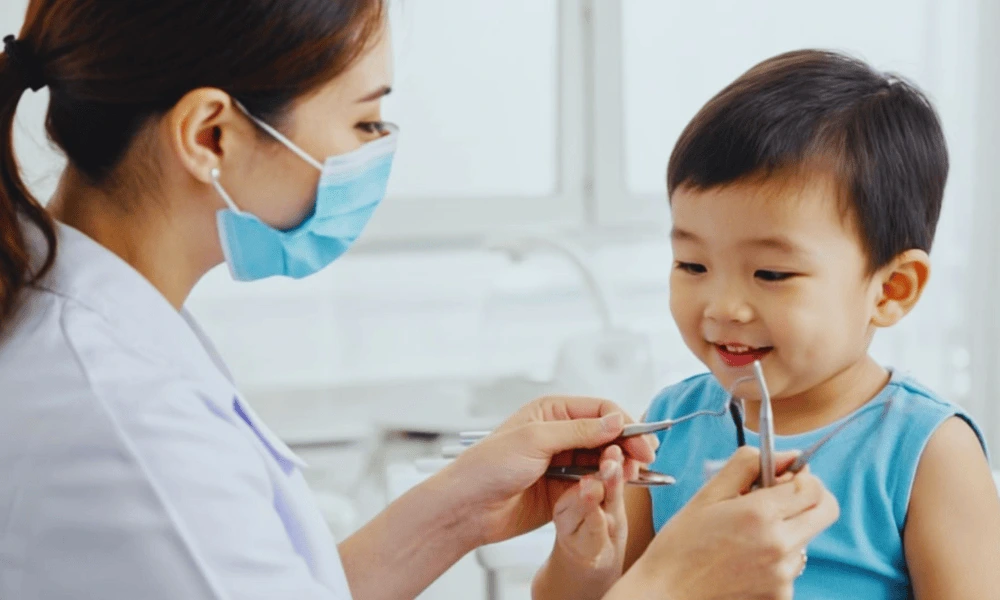
The first visit is gentle, with no drilling and no needles. Your child sits on your lap, the dentist counts their teeth, and they get used to the sights, sounds and smells of the office. A child who meets the dentist when nothing hurts is usually far more relaxed at 4, 5 or 6, when a filling or a sealant might be needed.
Tooth decay can start soon after the first teeth appear. The CDC's oral health tips for children report that more than half of children aged 6 to 8 have had a cavity in at least one baby tooth, and that untreated cavities can cause pain and infection that affect eating, speaking, playing and learning. Early decay often shows as chalky white or brown spots along the gumline, which a dentist can spot long before a child complains.
A common cause in babies and toddlers is falling asleep with a bottle of milk, formula or juice, which bathes the teeth in sugar all night. The AAPD advises against putting anything other than water in a bedtime bottle.
Most of what protects baby teeth happens at home, and the first visit is where parents get a plan. Your dentist covers how much toothpaste to use, how to brush a baby's teeth, when to start flossing, feeding and bottle habits, and how thumb sucking and pacifiers affect the teeth.
The AAPD calls an ongoing relationship with one dental office a dental home. Starting early means the team knows your child's teeth and history, and you know where to call if a tooth is chipped or knocked out.
Baby teeth hold the space for adult teeth, which start coming through at around age 6, so the ADA calls them "nature's braces". Regular checkups let the dentist watch the order in which teeth erupt, the spacing and how the jaws are growing, and refer early if something needs attention.
The first dental visit is short, usually 15 to 20 minutes, and focused on comfort rather than treatment. Most of it is a conversation with you. At the visit, the dentist:
Depending on your child's age and how settled they are, the dentist may gently clean the teeth and apply fluoride varnish, a thin protective coating painted on in seconds. Treatment at a first visit is rare; if anything needs attention, the dentist explains it and plans it for another day.
A little preparation makes the visit easier for both of you.
Keep it simple and upbeat: the dentist is a friendly helper who counts teeth and keeps them strong. Avoid words such as "pain", "shot" or "drill", which can make a child anxious before they arrive.
Picture books and videos about visiting the dentist help young children understand what will happen. Seeing the chair, the light and the mirror beforehand makes them less strange on the day.
Take turns being the dentist. Count your child's teeth, ask them to open wide and let them count yours. A practice checkup makes the real one feel familiar.
Choose a time when your child is usually rested and fed, and avoid nap time. A tired or hungry toddler finds any new place harder.
Young children take their cues from their parents. If you are relaxed and encouraging, your child is more likely to feel safe. Praise them for sitting in the chair or opening their mouth, even if the visit is short.
Bring your child's health information, any medicines they take, and a favourite toy or comfort item, and arrive a few minutes early so nobody feels rushed. Some children settle straight away and others need a few visits; both are normal.
The ADA's advice for keeping baby teeth free of cavities, from the ADA's guide to baby teeth:
Your dentist may recommend fluoride varnish at checkups and sealants on the back teeth once they come in. The CDC reports that fluoride varnish prevents a third of cavities in baby teeth, and that sealants prevent 80% of cavities in the back teeth. Our guide to why kids get cavities explains the other risks to watch.
After the first visit, the AAPD recommends a checkup every six months. Your dentist may suggest a different schedule if your child is at higher risk of decay, for example if they have already had a cavity.
Cost is often lower than parents expect. Covered California's 2026 pediatric dental benefit, which covers children up to age 19, lists the exam for children under 3 with counselling for parents, a child's cleaning, fluoride varnish and sealants at no charge in network. Employer plans vary, so ask us to check your child's benefits when you book.
At Smiles By Design in Carmel Mountain Ranch, children's visits focus on prevention and comfort: gentle exams, cleanings, fluoride, sealants, and advice for parents at every stage. For children who feel anxious, we introduce each step gradually and adapt visits for children with sensory sensitivities or other special needs. Families come to us from Carmel Mountain Ranch, Rancho Bernardo, Poway, 4S Ranch and across North County San Diego. Our guide to children's gum health covers what to watch for as your child grows.
Your child's first dental visit should be when the first tooth appears, and no later than their first birthday. That is the advice of both the American Academy of Pediatric Dentistry and the American Dental Association. Most babies get their first tooth at around 6 months, so the visit usually falls between 6 and 12 months.
The dentist may gently clean your child's teeth at the first visit if they are comfortable, and may paint on fluoride varnish to help prevent decay. For a young baby, the visit is often just an exam on your lap and advice for you. Nothing is forced; a calm first visit matters more than a full cleaning.
A child's first dental visit usually takes 15 to 20 minutes. Most of the time is spent examining the teeth and gums and talking with you about brushing, feeding and habits. Treatment is rarely done at the first visit, so the appointment stays short and easy for a small child.
Bring your child's health information and any medicines they take, your insurance details, and a favourite toy or comfort item. Write down any questions about teething, feeding, thumb sucking or toothpaste. Arrive a few minutes early so the visit starts calmly rather than in a rush.
It is normal for a young child to be nervous or to cry at the first visit. Some settle straight away and others need a few visits to feel at ease. The dental team takes things at your child's pace, keeps the visit short and can do part of the exam on your lap.
It is not too late. If your child is 2 or 3 and has never seen a dentist, book a visit now. The dentist checks for early decay, which is common by that age, and gives you a home care plan. Starting later is far better than waiting until something hurts.