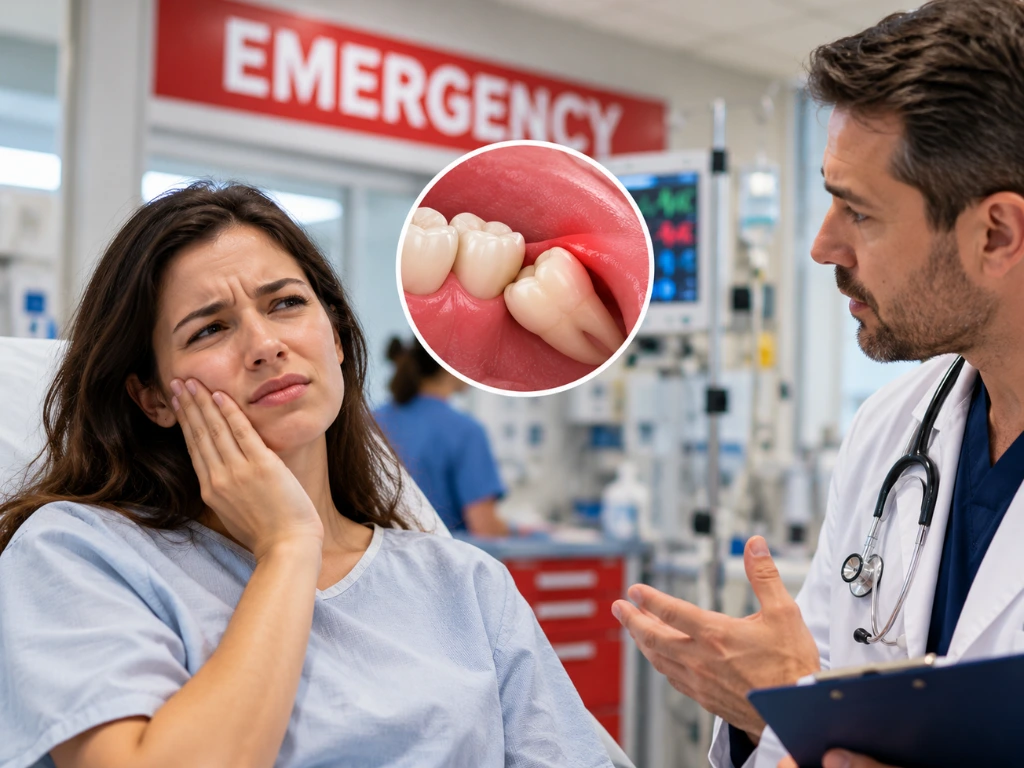


The ER can control tooth pain, prescribe antibiotics and manage an infection that threatens your airway, but it does not treat the tooth itself. Go to the ER for trouble breathing or swallowing, swelling under the tongue or near the eye, or fever with facial swelling; otherwise a same-day dentist visit treats the cause for a fraction of the ER price. This guide is for San Diego patients deciding where to go with a toothache.
Yes, the ER can help with tooth pain, but only up to a point: an emergency department controls pain, prescribes antibiotics for a spreading infection and protects your airway if swelling threatens it, while drainage, root canals and extractions happen at a dentist. From 2018 to 2022, 63% of US ER visits for dental problems ended with an antibiotic. Otherwise, our same-day emergency dental care treats the tooth.
The ER can examine you, rule out a dangerous spreading infection, bring the pain down and prescribe antibiotics when the infection has moved beyond the tooth. The 2025 clinical practice guideline written for emergency and urgent care settings sets out each step.
That guideline, published by Victoria Green and colleagues in the American Journal of Emergency Medicine in March 2025, adapts the 2024 American Dental Association pain guideline for clinicians who cannot offer dental treatment on site. "NSAIDs alone or in combination with acetaminophen are the first-line therapy for managing acute dental pain," the authors write.
In practice, an ER visit for a toothache follows this pattern:
The ER also handles what a dental office cannot. For a deep infection under the tongue, hospital treatment includes airway support, IV antibiotics and surgical drainage.
Money does not decide whether you are seen. Under the federal EMTALA law, every hospital emergency department must screen you and provide stabilising treatment regardless of your ability to pay, according to the Centers for Medicare & Medicaid Services.
The ER cannot treat the tooth that is causing the pain. Fillings, root canals, drainage of a tooth abscess and most extractions are dental procedures, and the 2025 emergency guideline tells clinicians to send patients on for definitive dental care.
That leaves the source of the pain in place. A nerve block wears off, and the decayed or infected pulp inside the tooth is still there the next morning. An infected tooth needs root canal treatment or extraction to stop the infection for good.
Antibiotics do not change that. The American Dental Association's 2019 antibiotic guideline in JADA recommends against antibiotics for most toothaches when dental treatment is available, because dental treatment, not medication, removes the source of the infection. "Antibiotics shouldn't be the first line of defense for dental pain and swelling," said Dr. Anita Aminoshariae, director of endodontics at Case Western Reserve University School of Dental Medicine and a co-author of that guideline.
ER prescribing has not caught up. A 2025 study in the Journal of Public Health Dentistry, using the National Hospital Ambulatory Medical Care Survey, found that dental problems made up 1.3% of US emergency visits from 2018 to 2022. Of those visits, 62.6% ended with an antibiotic. Opioid prescribing fell over the same period, from 33.2% of visits in 2018 to 25.4% in 2022.
Where this breaks down is the gap after discharge. Pain eases, the antibiotic course runs out and the abscess returns. Our article on dental abscess and jaw swelling explains why an abscess does not heal on its own.
Go to the ER, or call 911, if tooth pain comes with trouble breathing, swallowing or speaking, or with swelling that spreads under the tongue, down the neck or up towards the eye. These signs mean the infection has left the tooth.
The most serious example is Ludwig angina, an infection of the floor of the mouth that "often develops after an infection of the roots of the teeth," according to MedlinePlus, the US National Library of Medicine's consumer health service. The swelling can block the airway, and MedlinePlus states that Ludwig angina "can be life threatening."
Go to the ER, or call 911, for any of these:
A throbbing toothache, a tooth that hurts when you bite, or a small gum boil with no fever is a dental problem, not an ER problem. Our guide to signs an infection is spreading covers the stages in between. The 2019 ADA guideline draws the same line: a localised abscess without whole-body symptoms goes to the dentist, while a deep space infection or suspected sepsis needs urgent evaluation.

A dentist is the only one of the three that treats the tooth itself. Urgent care and the ER manage pain and infection, and the ER is the only one equipped for swelling that threatens your airway. The cost gap between them is large.
Urgent care treats tooth pain the way the ER does without a dental chair: an exam, pain relief advice or a prescription, and antibiotics when the 2025 guideline criteria are met. It cannot drain an abscess, fill a tooth or manage a threatened airway. The Health Care Cost Institute put the average urgent care visit at $220 in 2022, up from $195 in 2018, in a January 2026 release.
The ER adds long-acting nerve blocks, IV antibiotics, airway management and surgical drainage of deep infections. It is the right place for any red-flag sign above. It is also the most expensive. HCCI's analysis of 2021 claims put the average ER evaluation at $1,317, and the average ER visit including all services at $2,909.
A dentist diagnoses the tooth with dental X-rays and treats it: drainage of the abscess, a root canal, an extraction or an emergency filling. Smiles By Design offers a free emergency exam and X-rays. Elsewhere, the national median in-network rate for a problem-focused exam (CDT code D0140) was $130 in March 2026, based on price-transparency data compiled by PayorMap. Emergency treatment typically runs from about $100 for minor problems to $1,000 or more for a root canal or extraction.
Our stance: for tooth pain with no red flags, go straight to a dentist. Urgent care and the ER both end with the same referral, so the dental visit replaces them and finishes with the problem treated. Our guide to what counts as a dental emergency sorts the borderline cases.
If none of the red flags apply, manage the pain at home tonight and call a dentist when the office opens. A toothache without spreading swelling or fever does not need the ER.
Steps for tonight:
Smiles By Design is not a 24-hour dentist. Our hours are 8:30 am to 5:30 pm Monday to Thursday and 7:30 am to 2:00 pm on Friday, and we are closed at weekends. A toothache that starts on a Thursday night or Friday morning is worth a call before 2:00 pm on Friday, so it is treated before the weekend rather than in an ER waiting room on Saturday.
Call (858) 485-5552 as soon as the office opens and ask for a same-day emergency appointment. Smiles By Design offers same-day appointments for urgent dental problems, with a free emergency exam and X-rays.
At the visit, Dr. Dan Javaheri or Dr. Cody Cohen examines the tooth, takes X-rays and explains the diagnosis and treatment options. Treatment for emergencies includes:
If you are anxious about treatment, ask about sedation options: nitrous oxide, oral sedation, IV sedation and general anaesthesia.
Bring a list of the medicines you take, your insurance card, and any discharge papers or prescription from an ER or urgent care visit, so we can see what you have already been given. The practice accepts most insurance plans and is at 15373 Innovation Drive, Suite 110, in Carmel Mountain Ranch, San Diego, CA 92128.
The ER is built to keep a dental infection from becoming dangerous, not to end it. Its tools are pain relief, antibiotics when the guideline criteria are met and airway protection, and every ER visit for a toothache ends with the same referral to a dentist. So the choice comes down to the red flags. With trouble breathing, swallowing or swelling near the eye, go to the ER now. Without them, the faster route to a treated tooth is a same-day dental visit.
Toothache today? Call (858) 485-5552 or request a same-day emergency visit at Smiles By Design Dentistry in Carmel Mountain Ranch.
Urgent care can prescribe antibiotics for a tooth infection when you have swelling, a draining abscess or a fever and cannot reach a dentist within 48 hours, per the 2025 guideline for emergency and urgent care settings. The ADA's default choice is amoxicillin 500 mg three times a day for 3 to 7 days. The tooth still needs dental treatment.
Expect a referral, not an extraction. The 2025 guideline written for emergency departments covers pain relief, nerve blocks and antibiotics, and directs clinicians to send patients for definitive dental care such as extraction or a root canal. A dentist diagnoses the tooth with X-rays and removes it if it cannot be saved.
You can go to the ER for tooth pain without insurance. The federal EMTALA law requires every hospital emergency department to screen you and stabilise your condition regardless of ability to pay. You still receive a bill, and HCCI put the average 2021 ER evaluation at $1,317 before any other services.
Smiles By Design is not open 24 hours. The office runs 8:30 am to 5:30 pm Monday to Thursday and 7:30 am to 2:00 pm on Friday, with same-day emergency appointments. At night, manage pain at home and call at opening. Trouble breathing or swallowing means the ER or 911, at any hour.