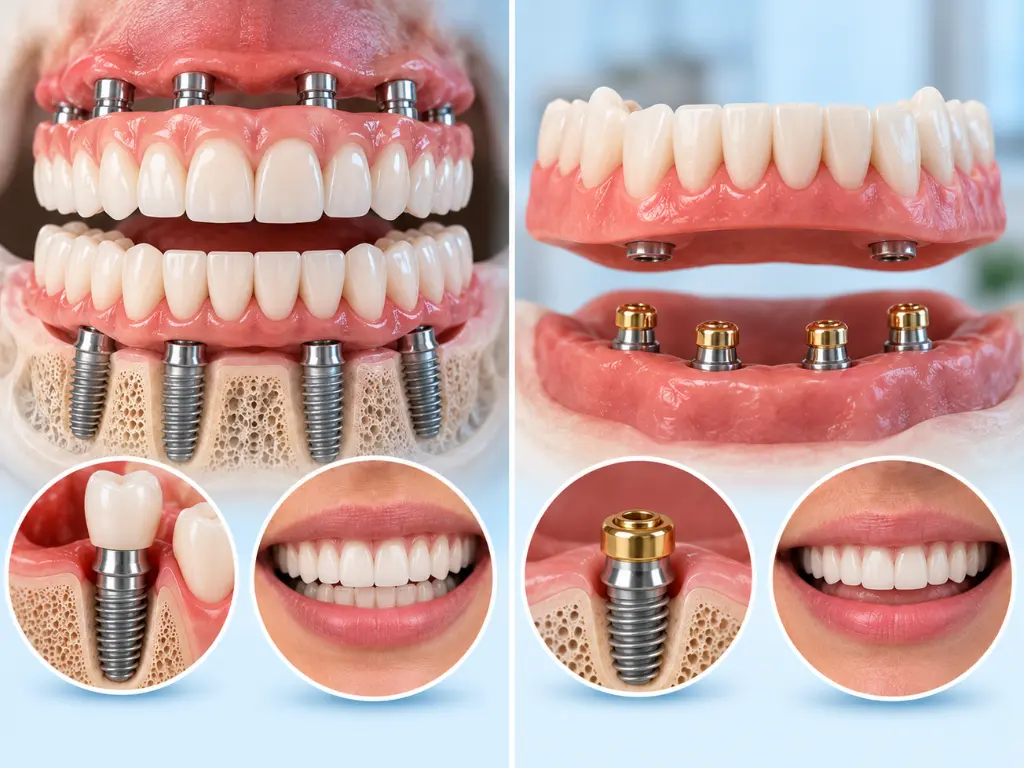


Full mouth dental implants with a fixed bridge cost $15,000 to $40,000 or more per arch, most often $20,000 to $35,000, on 4 to 6 implants. A snap-in implant denture on 2 lower implants costs about $5,600 at California in-network rates, which covers the implants, the attachments and a new denture. Comfort is a closer call than the price gap suggests: a 2018 ITI systematic review found no consistent winner between the two.
We wrote this guide for San Diego denture wearers and for patients about to lose all their teeth. Both options sit within our implant options from single teeth to full arches.
Your first decision is whether you want teeth that stay in your mouth all the time or teeth you snap out each night. Cost, cleaning and the number of implants all depend on that choice.
A fixed full-arch bridge is often called All-on-4, after the Nobel Biocare treatment concept.
Dentists also call these implant overdentures or anchored dentures.
The in-network figures above are reference rates from federal price-transparency files. Practice fees, ours included, run higher than negotiated rates. On the same rates, though, the implant bodies for a fixed arch cost more than a whole lower snap-in denture.
Fixed full mouth implants suit you if you want teeth that never come out, you have enough bone for 4 to 6 implants or you’re willing to have a graft, and you can clean under a bridge each day. A fixed bridge feels closest to natural teeth, because nothing covers your palate and nothing moves.
The research comparing the two is closer than the price tags suggest. In the 2018 ITI review, 4 of 9 studies on satisfaction favoured fixed bridges, 4 found no difference and 1 favoured snap-in dentures. On chewing, 8 of 11 studies found no significant difference. The authors concluded that “it is not possible to support a solid conclusion on which type of prosthesis would result in better PROMs”, meaning patient-reported outcomes.
Fixed bridges do better at protecting your bone. Goodacre and Goodacre’s 2017 literature review found the jawbone ridge shrank more under implant overdentures than under fixed complete dentures, because a snap-in denture still rests partly on the gums. Our article on why the jawbone shrinks explains how that happens.
Cleaning and bone volume are the weak points. The ITI review notes that a fixed bridge needs a design with cleaning access and a patient trained to use it. Fixed bridges also often need bone augmentation first, which adds cost and time.
Implant survival is high, though the long-term figures vary. A 2017 systematic review by Soto-Penaloza and colleagues reported 99.8% implant survival at 24 months for the All-on-4 concept. An independent appraisal on The Dental Elf re-ran the 5-year data and put survival between 86% and 97%. We have placed all-on-four implants in our office, including for a military veteran featured in our patient video.
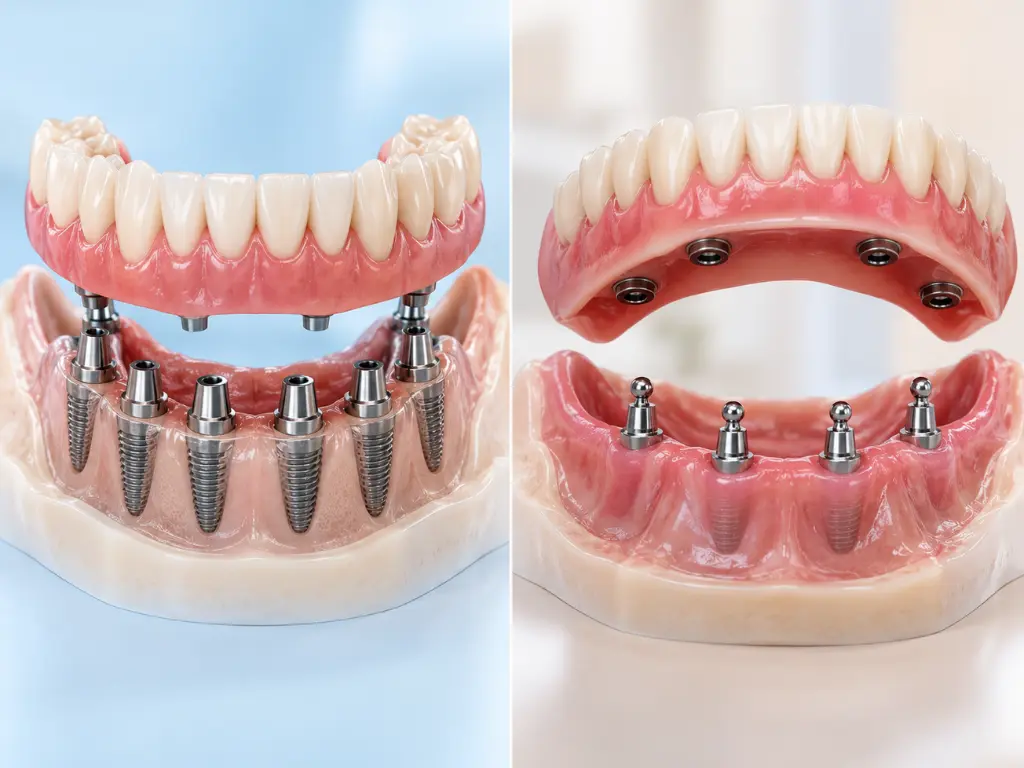
Snap-in implant dentures suit you if you want a denture that stops moving, at a fraction of the cost of fixed teeth. They also suit patients who need easy cleaning or extra support for the lips. For the lower jaw, the research points here first.
The 2002 McGill consensus, convened by Jocelyne Feine and colleagues, concluded that “the mandibular 2 implant overdenture is the first-choice standard of care for edentulous patients”. PubMed lists the statement as published in Gerodontology. With two implants under it, a loose lower denture clicks into place and stays there.
Snap-in dentures fit these situations better than fixed bridges:
You’ll spend more time on upkeep. Goodacre and Goodacre found implant overdentures needed more mechanical maintenance than fixed complete dentures, yet all but one study rated overdentures more cost-effective. The retention inserts wear down, and your dentist swaps them at recall visits. A University of Iowa dental training guide lists insert strengths of 1.5, 3 and 5 pounds of retention, and your dentist picks the strength at the recall visit.
Our guide to conventional denture types and costs covers the step before implants.
We can convert your current denture into a snap-in implant denture if it still fits well, the teeth aren’t badly worn and the acrylic is thick enough to hold the attachment housings. Your dentist hollows out the denture over each implant and fixes the housings into it at the chair.
The age of your denture decides whether conversion makes sense. Our denture page puts the typical life of a denture at 5 to 10 years. Near the end of that range, the teeth have worn and the fit no longer matches your ridge, and converting the denture locks those problems in. If your denture fits well and is under about 5 years old, convert it. If it’s older or loose, replace it, and put the conversion money towards the new denture.
Converting saves you the cost of a new denture. At California in-network rates, a lower conversion comes to $4,330 for two implants and two attachment abutments, against $5,572 with a new denture.
You can also start fixed treatment from your denture. Lab Management Today describes full-arch workflows where the lab turns your conventional denture into the screw-retained temporary bridge on surgery day. You wear it through a 4 to 6 month healing phase before the final bridge goes in.
If your current denture is loose or cracked, our team handles denture relines and repairs as part of the same assessment.
From consultation to final bridge, fixed full mouth implants take about 4 to 6 months and roughly 6 to 8 visits. A snap-in lower denture takes a little over 2 months and 4 to 7 visits. The gap comes from the healing period and from how much lab work your final teeth need.
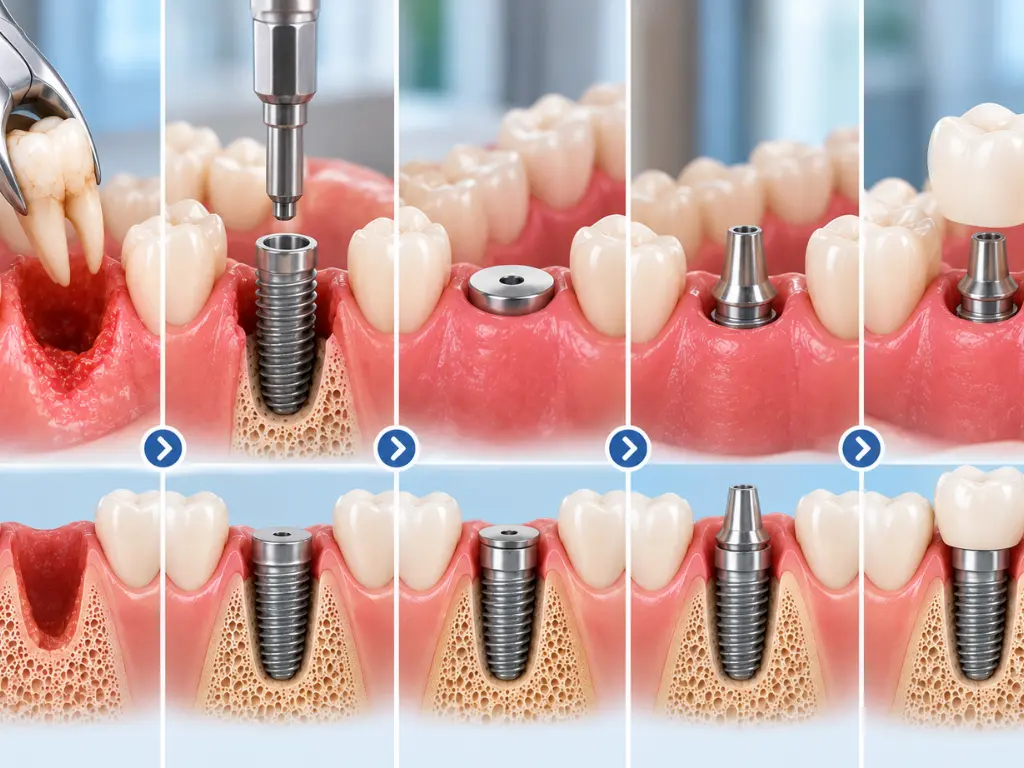
Fixed full mouth implants follow an immediate-loading path:
Snap-in implant dentures follow a conventional-loading path:
On both paths, surgery day is the long appointment. If you’d like sedation for implant surgery, oral or IV, you’ll need someone to drive you home that day.
Most patients pay for full-arch treatment with a mix of insurance, pre-tax health accounts and financing, because no single source covers all of it. Our implant page notes that most dental plans cover only part of implant treatment, if any.
Your insurance will cover a small part. National Association of Dental Plans data cited by ADA News in December 2025 puts 32.8% of in-network annual maximums between $1,000 and $1,500, against a $20,000 arch. Medicare.gov states that Original Medicare doesn’t cover most dental care, including dentures and implants.
Pre-tax accounts can cover more. IRS Publication 502 lists artificial teeth and dental treatment as qualifying medical expenses. For 2026, the IRS set HSA limits at $4,400 for self-only and $8,750 for family coverage, plus a $1,000 catch-up from age 55 (Rev. Proc. 2025-19). The health FSA limit is $3,400 (Rev. Proc. 2025-32).
A family HSA at the 2026 limit covers the $5,572 in-network figure for a snap-in lower denture, but only 43.8% of a $20,000 fixed arch. So for many patients, we suggest a snap-in lower denture now, paid from the HSA, with the option to move to fixed teeth later.
Financing can cover the rest. We offer financing options, including CareCredit, and our implant cost article notes typical plans of $200 to $500 a month. A $20,000 arch spread over 24 months at 0% comes to $833.33 a month. Check whether a promotion uses deferred interest, because if you still owe anything when it ends, the lender charges interest back to the purchase date.
A fixed arch costs about three to six times more than a two-implant lower snap-in denture. For that, you get teeth that never come out and better protection for your jawbone. The snap-in denture stops a loose lower denture from moving, and the McGill consensus calls it the first-choice standard of care. Decide which matters more to you, teeth that stay in or lower cost and easier cleaning, and that answer points to your option.
See both options planned on your own scan. Book a free full-arch consultation with Dr. Javaheri at Smiles By Design Dentistry in Carmel Mountain Ranch, or call (858) 485-5552.
With maintenance, All-on-4 implants last for many years. A 2017 systematic review by Soto-Penaloza and colleagues reported 99.8% implant survival at 24 months, and an independent Dental Elf appraisal estimated 5-year survival at 86% to 97%. The acrylic or ceramic teeth on the bridge wear faster than the implants, so you’ll need them repaired or replaced at some point.
Your dentist replaces the inserts whenever retention drops, and checks them at each recall visit. A 2010 systematic review by Çehreli and colleagues found that dentists replaced matrices more often after 5 years in both jaws. A University of Iowa training guide lists insert strengths of 1.5, 3 and 5 pounds.
Yes. Both terms describe a removable denture that clips onto dental implants, and the clinical term is implant overdenture. The 2002 McGill consensus recommends a two-implant overdenture as the first-choice standard of care for a toothless lower jaw.
Original Medicare doesn’t pay for full mouth dental implants or dentures. Medicare.gov lists dentures and implants among the dental items it doesn’t cover. If you saved money in an HSA before enrolling in Medicare, you can still spend it on implants, because IRS Publication 502 lists artificial teeth as a qualifying expense.