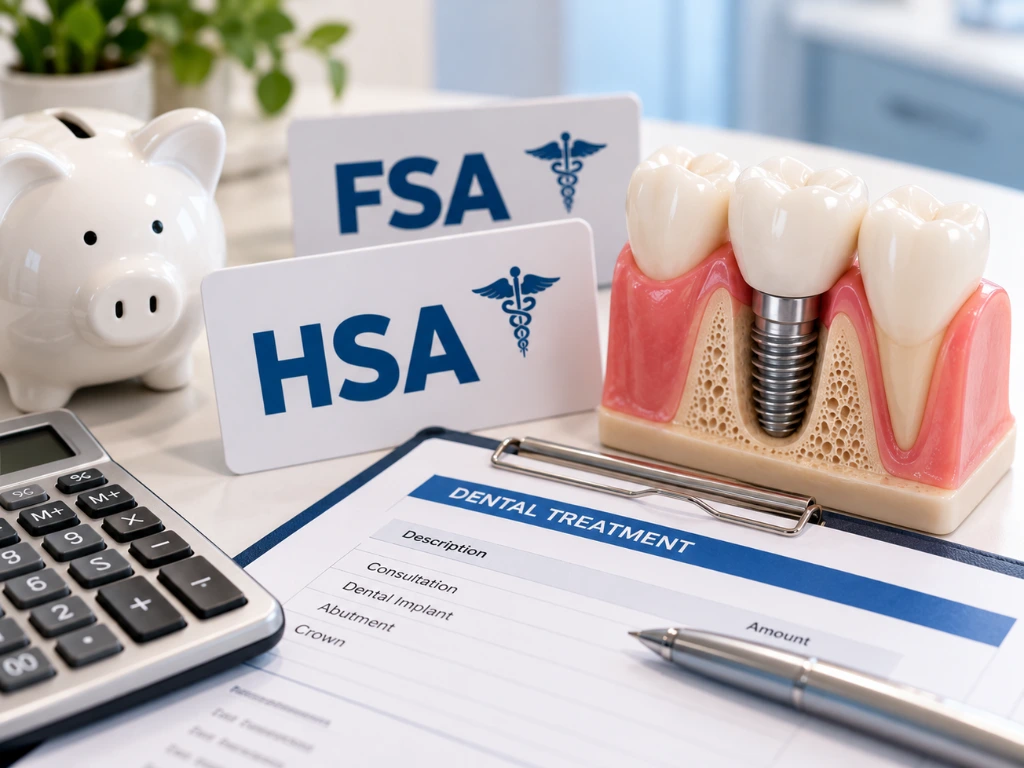


Yes. IRS Publication 502 counts artificial teeth and the treatment of dental disease as qualified medical expenses, so you can use HSA or FSA money for the implant, abutment, crown, bone graft and planning X-rays, for yourself or your family. Teeth whitening doesn’t qualify. For 2026 the limits are $4,400 for a self-only HSA, $8,750 for a family HSA and $3,400 for a health FSA.
We wrote this guide for San Diego patients planning implant treatment with pre-tax money, and it includes the California tax rule most national guides leave out. The same rules apply to all our single, bridge and full-arch implants.
Implants replace missing teeth, and IRS Publication 502 lists both “artificial teeth” and “the prevention and alleviation of dental disease” as includible medical expenses. HSA and FSA rules take their definition of medical care from the same section of the tax code, so anything that qualifies under Publication 502 qualifies for both accounts.
You won’t find “dental implants” as a separate entry in the publication. An implant crown is an artificial tooth, and the surgery that places the implant is a dental operation with a medical purpose. Together they cover every stage from extraction to final crown.
Most accounts won’t cover a whole implant on their own. The Employee Benefit Research Institute reported in August 2026 that the average HSA held $5,532 at the end of 2024. Our single implant price ranges run from $3,000 to $6,000 per tooth in the San Diego area, so many patients combine an account with insurance or a payment plan.
You can deduct dental implants only if you itemise and your total medical and dental costs come to more than 7.5% of your adjusted gross income, the floor set in IRS Publication 502. On an $80,000 income the floor is $6,000, so a single $4,500 implant gives you no deduction. A $25,000 full-arch case leaves $19,000 above the floor, which helps only if your itemised deductions beat the 2026 standard deduction of $16,100 single or $32,200 married filing jointly.
You can’t claim the same dollars twice. Publication 502 excludes anything you paid with a tax-free HSA distribution or that an FSA or insurer reimbursed.
An HSA is your own account. It rolls over every year and stays with you if you change jobs. An FSA is an employer plan that gives you the full annual amount on day one, but most of what you don’t spend expires at the end of the plan year. Both pay for implants with pre-tax money, and the big difference for an implant patient is when you can use the money.
For an implant patient, the two accounts differ in five ways:
California handles HSAs differently. The state doesn’t follow the federal HSA rules, so your HSA contributions count as California taxable income under Revenue and Taxation Code section 17215.4. The state’s Office of Tax Appeals confirmed this in the 2023 Appeal of E. Yan. You still get the federal saving: a family HSA at the $8,750 limit saves $1,925 of federal tax in the 22% bracket.
For a planned implant, we find the FSA works better in the year of treatment, because you can spend the whole $3,400 from day one. For a plan that runs over several years, such as a full arch, the HSA does better because the balance keeps building. “People use their HSAs differently the longer they have their accounts,” said Paul Fronstin, director of health benefits research at EBRI, in August 2026.
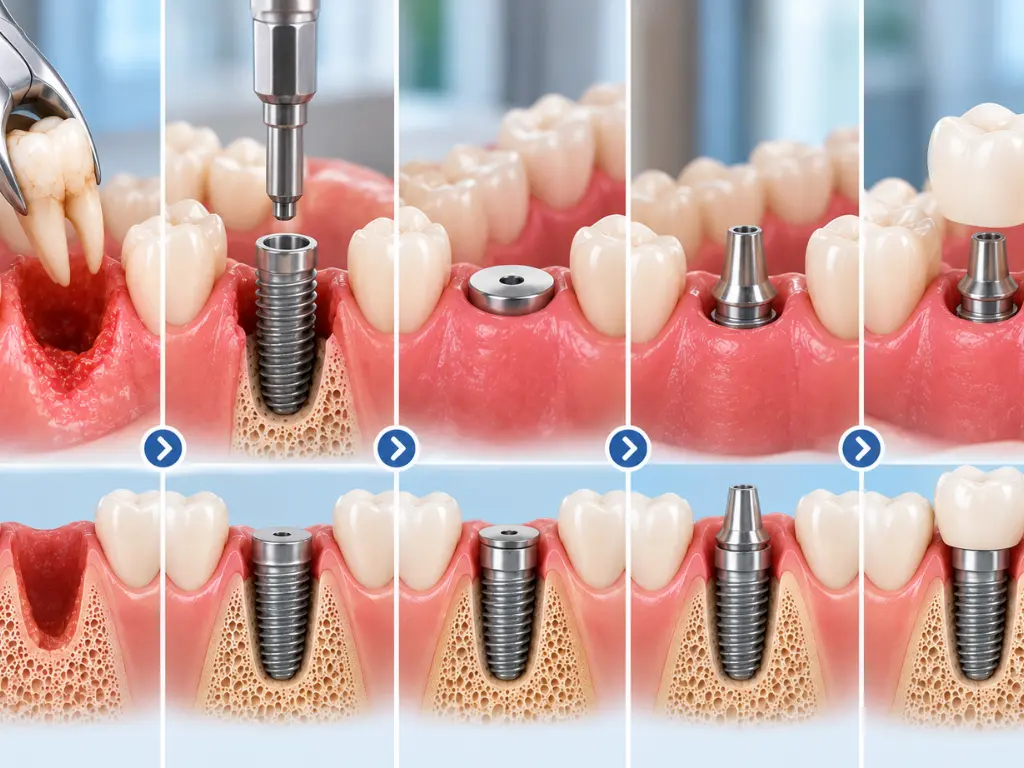
Every stage of implant treatment is eligible, because each one treats a missing or failing tooth. Cosmetic-only work isn’t, and Publication 502 names teeth whitening as excluded.
You can pay for these with HSA or FSA money:
You can’t use the accounts for:
If you’re unsure about an item, ask your account administrator before treatment. A short treatment note from our office explaining that the work replaces a missing or damaged tooth settles most questions.
On a calendar-year plan, you have to spend your FSA money on care you receive by 31 December. Your employer can add a grace period of up to 2½ months (to 15 March) or a carryover of up to $680 into 2027. According to IRS Publication 969, a plan can offer one of these but not both.
Timing trips up a lot of implant patients. Publication 969 states that an FSA “can’t make advance payments for future or projected expenses”. If you pay a deposit in December for surgery in February, the deposit doesn’t count as a 2026 expense. The FSA pays for each stage of treatment once you’ve had it.
For a multi-stage implant, plan like this:
Set your FSA election to match your treatment plan. A full arch spread over two plan years can draw on two FSA elections of $3,400 each, with each stage claimed in the year you have it.
Your PPO insurance pays first, and your HSA or FSA covers what’s left: the deductible, your coinsurance share and anything above the annual maximum. You can’t use the account for any amount the insurer pays. Publication 969 also requires FSA claims to include a statement that the expense “hasn’t been paid or reimbursed under any other health plan coverage”.
Say you need an implant and crown at the California in-network medians from March 2026 price-transparency data, $1,829 and $1,287, or $3,116 in total. On a plan that covers implants at 50% with a $1,500 annual maximum, the insurer pays $1,500 and you owe $1,616. A 2026 FSA election of $3,400 covers your share and leaves $1,784 for other care.
Submit to your dental insurer first and wait for the explanation of benefits (EOB). Then claim your share from the FSA, or pay it from the HSA. The FSA administrator uses the EOB to see which part insurance didn’t pay.
Our office accepts most insurance plans and reviews your coverage at the consultation. You’ll know the insurer’s share before you decide how much of the balance goes on the FSA, the HSA or a payment plan.
Keep an itemised receipt for every stage of treatment, along with the insurer’s explanation of benefits. FSA administrators need proof from a third party before they pay, and as an HSA owner you need records in case the IRS asks. Publication 969 requires FSA claims to include “a written statement from an independent third party stating that the medical expense has been incurred” and the amount.
An itemised receipt for implant treatment shows:
A credit card slip on its own won’t do, because it shows neither the service nor the date you received it.
If you have an HSA, keeping records is up to you. Publication 969 requires records showing that you spent the money only on qualified medical expenses, that you didn’t pay those expenses from another source and that you didn’t itemise them in any year. It also tells you not to send these records with your tax return. Keep a folder for each tax year, with the receipt and EOB for each stage.
You can use HSA and FSA money for every clinical stage of a dental implant, and each account suits a different kind of plan. Your FSA gives you the whole election on day one, and you lose whatever you haven’t used by 31 December, so book treatment stages around your plan years. Your HSA keeps growing, which suits a full-arch plan, though California taxes the contributions. Let insurance pay first, use the accounts for the rest, and keep an itemised receipt for each stage.
Plan your treatment around your benefits. Book a free implant consultation at Smiles By Design Dentistry in Carmel Mountain Ranch, or call (858) 485-5552.
Yes, you can still spend HSA money on dental implants after you enrol in Medicare, but you can’t add to the account any more. IRS Publication 969 sets your contribution limit at zero from the first month of Medicare enrolment. Medicare.gov states that Original Medicare doesn’t cover dentures or implants, so the HSA savings you already have can fill that gap.
Yes. IRS Publication 969 defines qualified medical expenses as medical care for you, your spouse and your dependants. The 2026 family limit of $8,750 applies to the account as a whole. Keep the itemised receipt under the patient’s own name.
Yes, at the state level. California doesn’t follow the federal HSA rules, so your contributions count as California taxable income under Revenue and Taxation Code section 17215.4, which the Office of Tax Appeals confirmed in 2023. You still get the federal tax savings, and you can spend the money on implants the same way.
No. IRS Publication 969 states that an FSA can’t make advance payments for future or projected expenses. Pay the deposit another way, then claim from the FSA after each stage, such as the implant placement or the crown, has taken place.