

When a tooth gets damaged, whether from decay, a fracture, or just general wear, restoring its strength and function matters; things tend to get worse otherwise. Depending on the severity of the damage, your dentist might recommend an inlay, an onlay, or a full crown.
All three exist to repair your tooth, but they do so differently, mainly in how much of the tooth they cover and when each one makes sense. Knowing the difference between these three can help you understand exactly why your dentist is recommending one over the others.
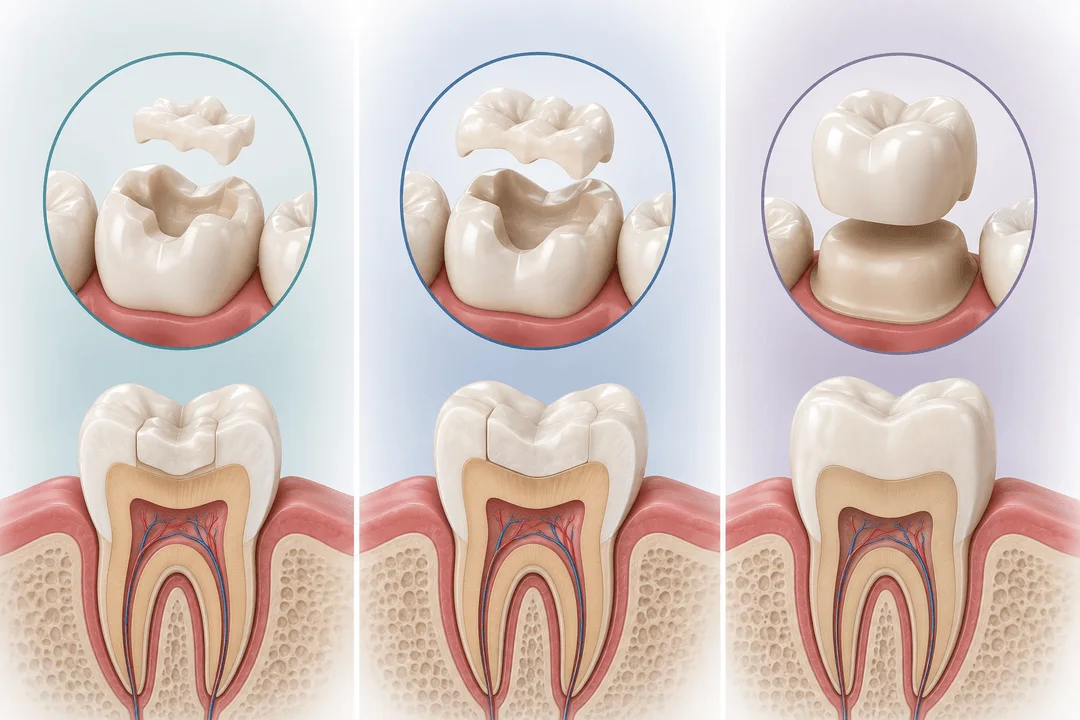
An inlay is a custom-made piece that repairs damage sitting inside the chewing surface of your tooth. It is fitted tightly into the natural ridges of the tooth and is often used when the cavity is too large to be filled but not severe enough to warrant a complete crown.
Typically crafted from porcelain, ceramic, or composite resin, inlays are durable and blend seamlessly with the surrounding teeth.
Your dentist might recommend an inlay when:
An onlay works a lot like an inlay, but it covers more ground. Where an inlay stays within the ridges of the tooth, an onlay stretches over one or more of those ridges for extra protection and support.
Because of that wider coverage, people sometimes refer to onlays as "partial crowns." They let your dentist save more of your healthy tooth while still fixing areas that have taken on moderate damage.
Your dentist may recommend an onlay if:
Dental Crowns primarily cover the visible part of your tooth, everything above the gumline. Dentists usually recommend a crown when a tooth has serious damage, extensive decay, large existing fillings, or just isn't structurally strong enough on its own.
A crown includes the entire tooth, restoring its strength, proper function, and a natural appearance, and helps protect any remaining tooth structure below it.
Crowns typically come into play for:
The real difference comes down to how much of your natural tooth still needs protection and restoration.
Honestly, it all depends on the actual condition of your tooth.
If the damage is sitting mostly in the center of the tooth and you've still got healthy structure around it, an inlay can be a solid, conservative fix that holds up well.
If the damage extends beyond the center and affects one or more ridges, an onlay can strengthen your tooth while preserving more of the natural tooth than a full crown would.
A crown will provide the most protection and life expectancy when the tooth is severely decayed, fractured, or structurally unsound.
Every case looks different, so your dentist needs a full evaluation before recommending the right one for you.
Related Blog:
Each of these options can be used to repair a damaged tooth, but they are all suited to different situations and will depend on the amount of healthy structure remaining in the tooth. Restoration that is a proper fit will allow you to retain more of your natural tooth structure and provide the necessary strength for long-term success.
At Smiles By Design Dentistry, we tailor every treatment to each patient’s unique situation. Our team carefully evaluates the condition of every tooth and develops personalized restoration plans designed to balance durability, aesthetics, and tooth preservation, helping patients make confident decisions about their dental care.