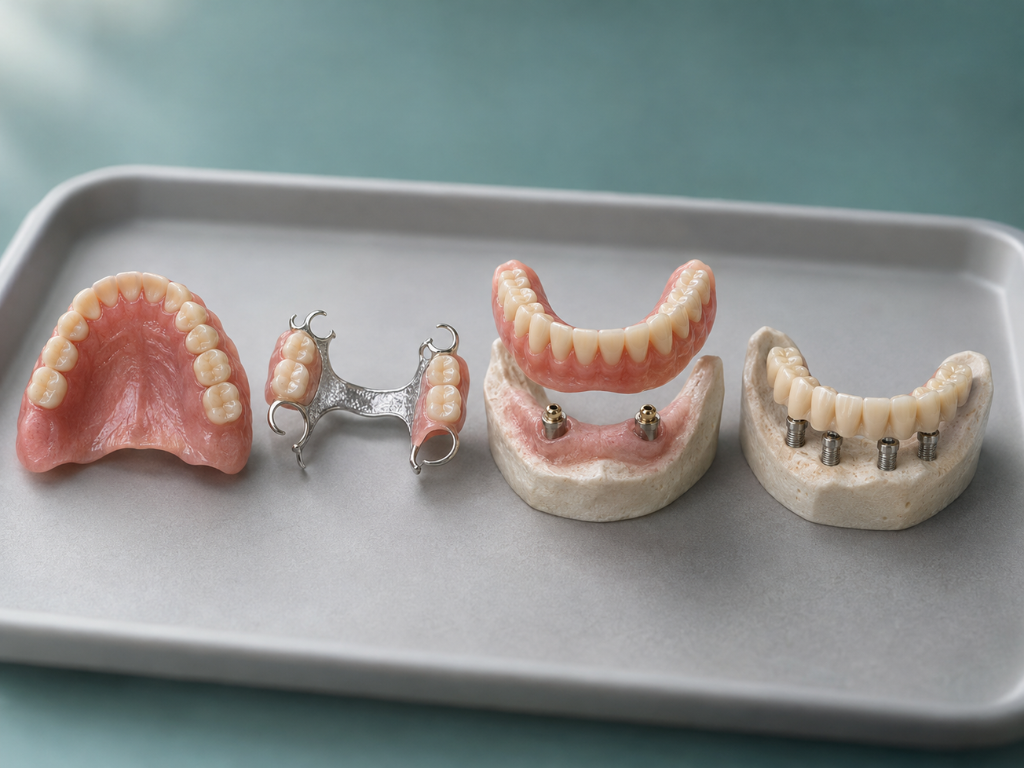


The four main types of dentures are full, partial, immediate and implant-supported, and the best one depends on how many healthy teeth you have left and how well your jaw can hold a denture. If your teeth can't be saved, or your denture won't stay put, this choice shapes daily life for years.
Our dental implant options page covers the implant-backed choices, and Smiles By Design Dentistry of San Diego in Carmel Mountain Ranch fits all four.
Dentures differ mainly in what holds them in place: your gums, your remaining teeth or implants in your jaw. We cover all four on our dentures in San Diego page, and each one changes daily life in a different way.
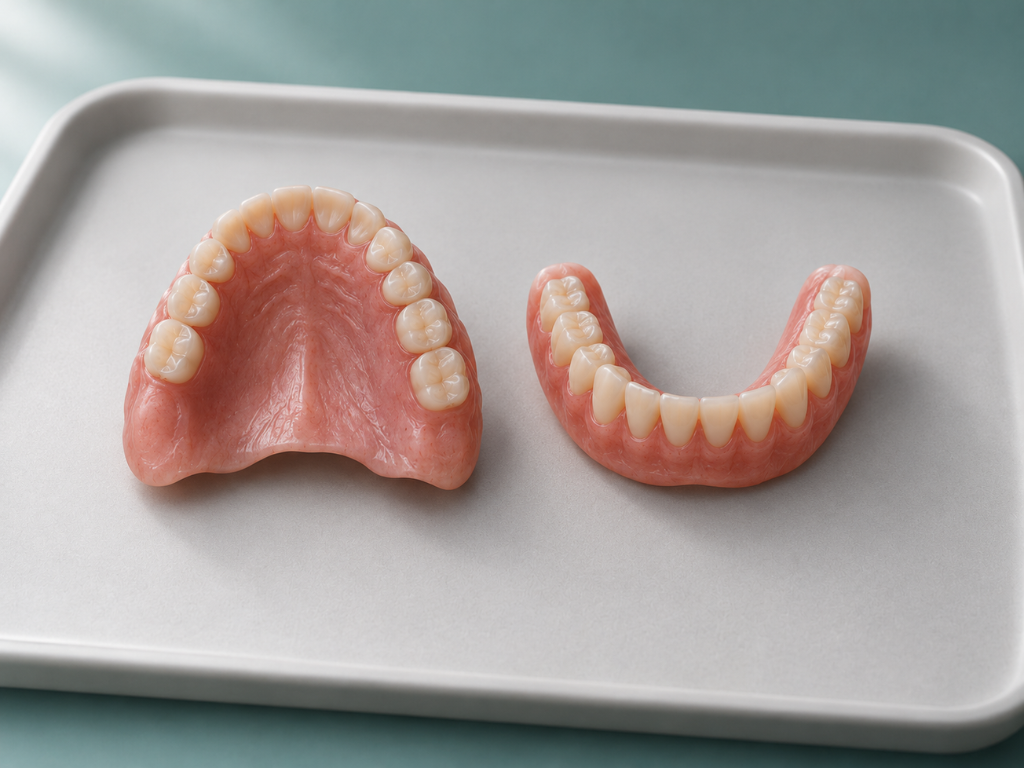
A complete denture replaces every tooth in the upper or lower jaw, set in an acrylic base, the gum-colored part that rests on your gums. An upper holds on by suction because it covers the roof of your mouth, so it's usually steady. A lower has very little grip and relies on your tongue and cheek muscles to stay down, and that's why lowers cause the frustration.
You'll have roughly a fifth to a quarter of the chewing power of natural teeth, so steak and raw apples take practice. Your jaw keeps changing too. Once tooth roots are gone the bone slowly shrinks, which we call jawbone resorption, so a denture that fit well on day one gets looser over the years.
A partial denture fills the gaps when you still have healthy teeth, clipping onto them with small clasps. It also stops those teeth drifting into the spaces. If only one or two teeth are missing in a row, weigh up a bridge or partial denture before you decide, because a bridge doesn't come out.
Partials come in three builds. A cast metal framework is thin and strong, so it's our pick for long-term wear, though a clasp may show when you smile. An acrylic partial, or flipper, is light and cheap but breaks easily, so we treat it as temporary. A flexible nylon partial has no metal clasps, but it's harder to adjust or add a tooth to later.
Immediate dentures go in the same day your teeth come out, so you're not seen without teeth. We take impressions before the extractions, which means the denture is built on our best estimate of how your gums will heal. It's the right call if you can't go without teeth, but it won't be the best-fitting denture you ever own.
By about three weeks, your gums and bone have shrunk enough that it feels loose and sore spots appear. Expect a soft reline, a cushioned lining that tightens the fit, within the first month. Then comes a hard reline or a second denture around six months, and that cost isn't part of the original price.
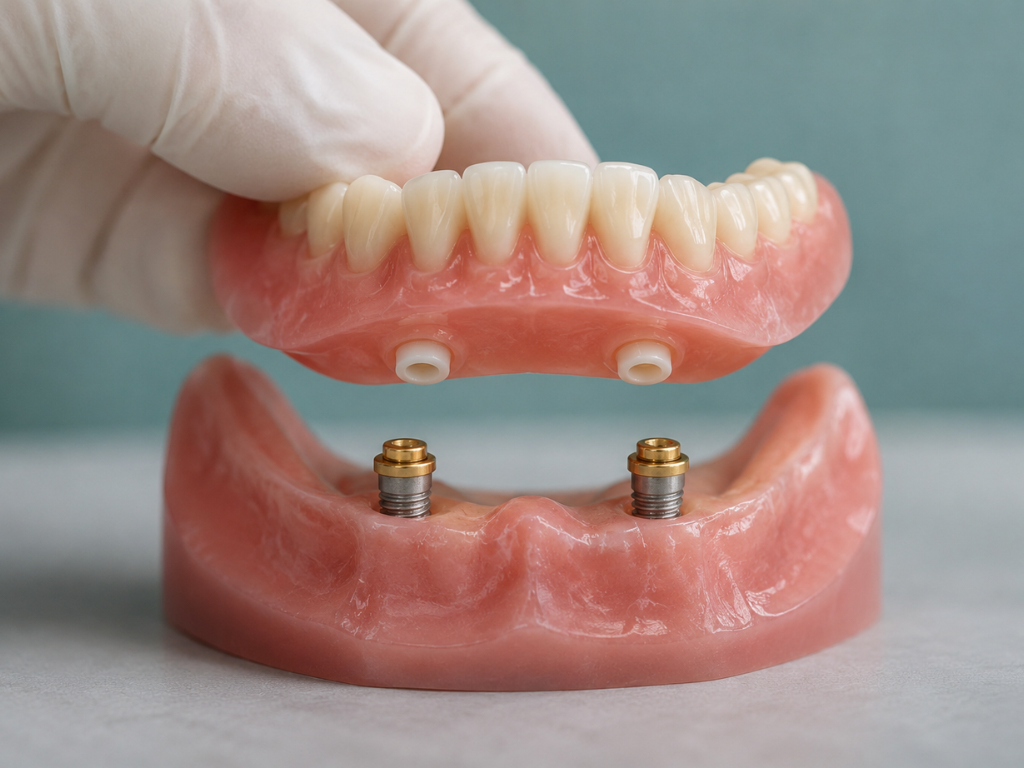
Implant-supported dentures attach to titanium implants in your jawbone, and this name covers two very different things. An implant overdenture, the snap-in kind, clips onto locator attachments, small snaps on top of the implants, and comes out at night for cleaning. Two implants usually do the job for a lower denture, while an upper needs more.
The other kind is a fixed full arch on four to six implants, which only a dentist can remove. Ask which one a quote means, because a snap-in lower runs about $5,600 at California in-network rates and a fixed arch runs $15,000 to $40,000 or more.
You'll notice the denture stops lifting when you talk and eat, and you can drop the adhesive. In exchange you need enough jawbone, minor surgery and a few months of healing, and the nylon inserts wear out and need swapping.
The best denture keeps every healthy tooth you can and stays still when you eat. Here's what we'd pick for each situation.
If you still have healthy teeth, we'd choose a cast metal partial and keep them. Those teeth steady the partial and hold their share of the bite, so pulling them to "get it over with" is a mistake you can't undo.
If your remaining teeth have to come out and you can't go without teeth, start with an immediate denture and budget for what follows.
If you're healed and only need an upper, a well-made conventional denture is often all you need, because suction does the work.
If your lower denture won't stay down, we'd put your money into two implants before anything else. Nicer teeth or a new lower won't fix a denture that lifts every time your tongue moves. Two implants will.
If you want teeth that stay in for good and you have the bone for it, look at a fixed arch. If arthritis makes cleaning hard, a snap-in is easier to look after, because it comes out and you can clean it at the sink.
If surgery isn't an option, a conventional denture with regular relines is still a good answer. Our comparison of dentures vs implants goes deeper on that decision.
Dentures, bridges, implants and gum treatment all sit on our list of dental services, so you can compare them at one office without being sent elsewhere.
Premium dentures are worth it when they'll be your teeth for years, and economy dentures are fine as a stopgap. Neither is an official type, because both are labels used by labs and dental offices, so a lower price can mean almost anything. Ask what's different.
The main difference is usually the teeth. Economy dentures tend to use standard acrylic teeth that look more uniform and wear faster, while premium dentures use harder, more natural-looking teeth with more shade choices. National averages run about $452 for basic dentures, $1,968 for traditional and $6,514 for premium.
Premium makes sense if your front teeth show when you talk and you plan to wear this denture for years. Skip it on an immediate denture you plan to replace once you've healed.
The part that matters more than the label is fit. Ask whether the price includes a wax try-in, a trial version of your denture you can check in your mouth before it's finished, and whether adjustments are included. Without that step, you won't see your teeth until they're done. Dental plans usually pay by denture type, so the upgrade tends to come out of your pocket.
A full denture runs about $1,240 per arch at California in-network rates, and national averages are about $1,740 to $2,230 for a partial and $2,180 for an immediate denture. Implant work costs more because you're paying for surgery and attachments too. These are market figures, not our fees, and our guide to how much dentures cost shows what's behind them.
Extractions, a second arch, better teeth and implants push the price up. Your first quote also isn't your full cost, because relines and repairs come later, so compare what each option costs over five years.
Implants last the longest, often for decades, but the denture on top still wears out in about 5 to 10 years like any removable denture. The fit tends to go before the teeth do, so plan on a reline every one to two years.
A soft reline adds a cushioned layer for sore or healing gums, and it's a short-term fix. A hard reline adds firm acrylic to match your gums and lasts much longer. A rebase goes further, replacing the whole pink base while keeping your teeth, which suits a denture with good teeth and a tired base. Once the teeth are worn down, replace it.
Snap-in dentures need the same relines, plus new inserts when the snap weakens. They hold their fit better where the implants sit, because implants help keep the bone around them.
The costliest mistake is comparing dentures on the first price alone. Two quotes can look far apart until you add the try-ins, adjustment visits and later relines.
The next is living with a bad fit. If you need more adhesive each month, your denture is telling you it no longer matches your gums. Home reline kits and glue can warp the base and throw off your bite, so bring it in instead. Wearing a loose denture for too long also speeds up bone loss and leaves sore spots.
The last is judging too soon. A new denture can feel bulky for weeks, and learning to eat and speak with it can take months. Sore spots in the first days are normal and quick to fix at a follow-up.
Your remaining teeth, your jawbone and your bite decide it, and none of those can be judged from a photo. To give you a straight answer, we'd need to examine your gums and teeth, then check your bone on X-rays or a 3D scan. If you wear a denture now, bring it, along with your insurance details.
Dr. Javaheri is certified by the California Academy of Implant Dentistry, and he and Dr. Cohen share a conservative approach, so you'll hear when a simpler option will do.
Keep every healthy tooth you can with a cast metal partial. If your teeth have to come out, start with an immediate denture and budget for the reline that follows. If your lower denture won't stay down, put the money into two implants first. To confirm the right fit, we need to see your gums, remaining teeth and jawbone.
Book a free consultation at Smiles By Design Dentistry in Carmel Mountain Ranch, or call (858) 485-5552.
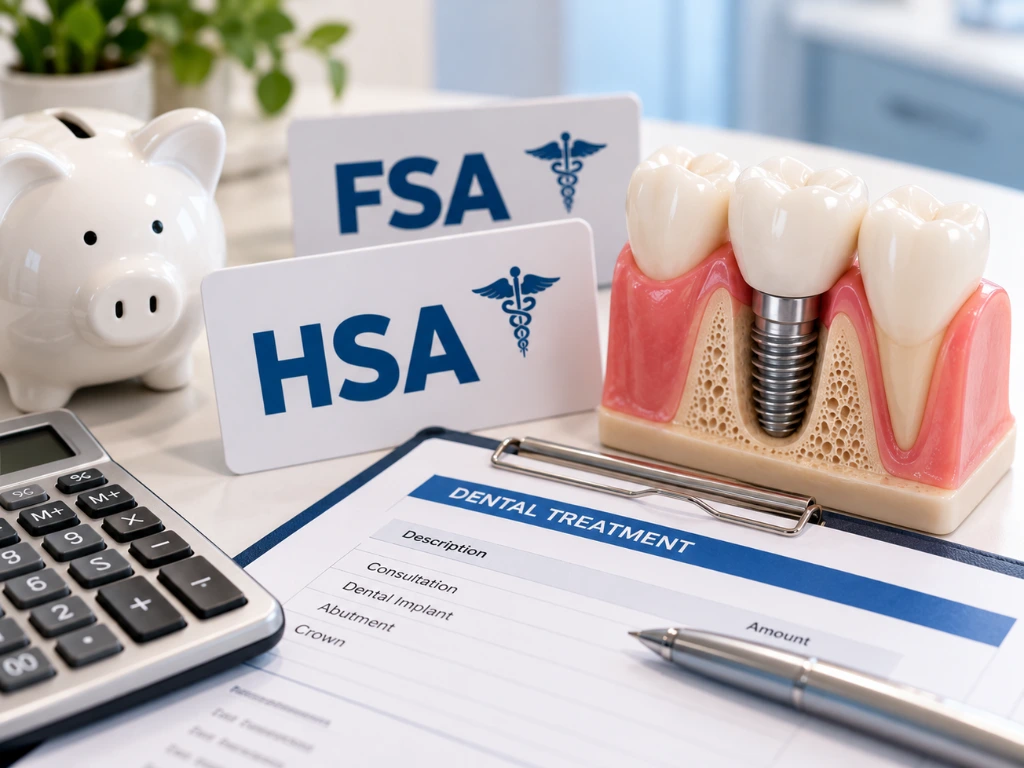
Usually in part, up to your plan's annual maximum. Smiles By Design reviews your coverage at your consultation. Medicare doesn't cover dentures in most cases, while adults on a Covered California dental HMO pay a $400 copay for a complete or immediate denture in 2026. HSA or FSA money can pay for dentures too.
Yes, if your jaw has enough bone for implants. A lower denture that still fits well and has good teeth can sometimes be converted, which runs about $4,330 at California in-network rates. If yours is old or loose, Smiles By Design would usually suggest a new denture rather than building on a poor fit.
Take them out at night once you're past the first days. Your gums and jaw need four to eight hours of rest a day, or you risk irritation and infection. Immediate dentures are the exception early on, so Smiles By Design asks you to keep them in for the first 24 hours. After that, follow your own instructions.
Immediate dentures go in the day your teeth come out. A conventional denture takes several weeks across impressions, a wax try-in and fitting, and often waits a few months for your gums to heal after extractions. Implant-supported dentures take longest, because the implants need months to bond with your bone.